Thursday, May 29, 2014

April 28, 1864 (Saturday): Leaving Defenses Thin In Washington

Civil War Culpeper (O'Sullivan)


WASHINGTON, April 28, 1864- 3.30 p. m.
Lieutenant- General GRANT,
Culpeper, Va.:
    General Augur has been stripped of almost everything available to give to General Burnside. When the trains cease to run the guards under General Briggs can be placed in the block- houses, between Bull Run and the Rappahannock. I will also give him the Massachusetts detached artillery as soon as it arrives. No troops are yet available to replace Abbot's artillery in the fortifications. Perhaps some
militia or invalids from the West amy arrive in time. If not, we must weaken the other garrisons. There is very little left outside of Burnside's command to use against any movement of Longstreet. The Navy Department says that one iron- clad left New York and one left Philadelphia on the 26th, and should reach Fortress Monroe to- day. The one from Boston touched at New York, and will leave there to- morrow.


   H. W. HALLECK,
   Major- General, Chief of Staff.

Official Records, Series I., Vol. 33, Part 1, Pages 1002-1003.

Two years before the administration was at loggerheads with McClellan over whether he was leaving adequate troops to man the defenses of Washington.  Now, under Grant, those same defenses were being stripped to allow Grant to maintain forces in front of Lee on the Rappahannock and in Eastern Virginia.  At this point war planners were still uncertain exactly where Longstreet and his forces were located and what their intentions were.

April 27, 1864 (Thursday): Longstreet of the Valley?

"Shenandoah Valley" (William Lewis Sonntag)


CULPEPER, VA., April 27, 1864-1.30 p.m.
(Received 3.20 p.m.)
Major General H. W. HALLECK,
Chief of Staff:
     There are rumors brought in by deserters that Longstreet, re-enforced by Beauregard's troops, will move down the Shenandoah Valley. Should they do so, throw all the force as necessary. If such a movement is commenced by the enemy after we start from here I will follow him with force enough to prevent his return south.


     U. S. GRANT,
     Lieutenant-General.

Official Records, Series I., Vol. 33, Part 1, Page 992.

The Confederate high command had considered any number of options.  But it was now a settled issue.  Longstreet's troops, moving from Charlottesville, were now beginning to rejoin Lee's Army of Northern Virginia.  Beauregard was giving up troops from the coast of South Carolina, given the weather made campaigning there difficult he was able to let some troops go. 

Wednesday, May 28, 2014

April 26, 1864 (Wednesday): Again to Familiar Ground

Fredericksburg (npsfrsp.wordpress.com)


HEADQUARTERS ARMY OF THE POTOMAC,
April 26, 1864-10.30 a.m.
Major General A. E. BURNSIDE:
    I have now a pontoon bridge over the Rappahannock at the railroad crossing, in addition to the railroad bridge, which is planked over and can be passed by wagons. I shall take up the pontoon bridge when my troops are relieved. If you require another one, Brigadier-General Benham, at Washington, has been directed to furnish it, with the necessary working party, to lay and take care of it.


    GEO. G. MEADE,
    Major-General.

Official Records, Series I., Vol. 33, Part 1, Page 990.

Again to the bridges into Fredericksburg, again to Hamilton's Crossing, again to the plains of Fredericksburg.  A familiar play, but with a new actor (Grant) in the lead role. 

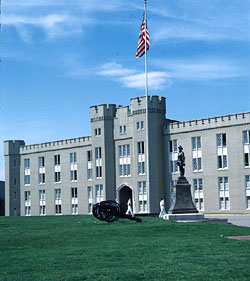
April 25, 1864 (Tuesday): The VMI Corp of Cadets Is Offered For Service

VMI Lexington, VA


HEADQUARTERS ARMY OF NORTHERN VIRGINIA,
April 25, 1864.
Major General WILLIAM H. RICHARDSON,
Adjutant-General of Virginia, Richmond:
    GENERAL: Your letter of the 22nd instant, inclosing that of General Francis H. Smith, in which he proposes to tender the services of the Corps of Cadets at the Virginia Military Institute for the approaching campaign, is received. I desire to express my appreciation of the patriotic spirit that actuates General Smith in making this proposal, and my gratification at finding that it meets with your concurrence. I do not think, however, that it would be best at this time for the corps to be called to this army. It is now in a situation to render valuable aid in defending our western frontier, which may be menaced simultaneously with the general advance of the enemy in the east. It will thus prevent the necessity of detaching troops from this army. I think it would be advisable for General Smith to hold the command in readiness to co-operate with General Breckinridge and General Imboden in case of necessity, and to notify those officers of the fact. Should it at any time become necessary or expedient to have the services of the cadets with this army, it is very gratifying to me to know that they are so fully placed at my disposal.
    Very respectfully, your obedient servant,


    R. E. LEE,
   General.

Official Records, Series I., Vol. 52, Part 1, Page 875.

VMI's cadets represented the future of the Confederate Army, but the future was in question.  Smith's offer was not accepted by Lee at this time, but before the year was over the cadets would see action at New Market.  For the time being, they provided a ready force in the Valley which meant Lee could avoid sending troops from his own command to the Valley.


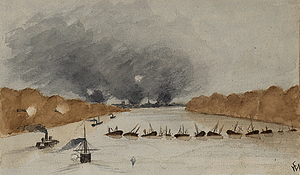
April 24, 1864 (Monday): The Threat of A Single Gunboat

Union Gunboats Advancing on New Berne


HEADQUARTERS SUB-DISTRICT OF NEW BERNE,
New Berne, N. C., April 24, 1864.
Commander H. K. DAVENPORT,
Senior Naval Officer, Sounds of North Carolina:
    SIR: I wish to call your attention to a few facts which, mentioned kindly, I hope you will take the same way, as I only say these things as a matter of duty, believing it for the best interests of both services.
    You understand perfectly the situation of affairs here as far as the rebel ram on the Neuse is concerned, and you must be aware that if that ram is permitted to come into this harbor the shipping, gun-boats, &c., must be destroyed or driven away, and the town itself liable to destruction. I have done everything in my power to avoid such a disaster. The forces under my command have picketed
river on both sides, and the work on the blockade has been pushed as rapidly as possible. For months there has been no boat stationed anywhere near the blockade.
    You will recollect that on the day before yesterday I earnestly urged you to send one of the small-boats, under your orders, to a point up the river where all parts of the blockade could be seen from her decks, and that small boats should at night row up nearer, in order to give us timely notice of any attempt to interfere with the work or to break through. There are points where such a gun-boat can lie perfectly well, and on the night before last I did find at mid-night when I made the rounds that the Lockwood or some other of the small gun-boats was lying in the channel between Fort Stevenson and Fort Anderson in a good position to see everything. Last night, however, there was no boat on the watch, and at 1.30 o'clock this morning, when Lieutenant Ward returned from his reconnaissance up to Swift Creek, there were no naval boats of any description seen higher up the river than where the Commodore Hull is lying.
    Now, commander, do you not think that as these gun-boats lie quietly at their moorings for twenty-five days or more in every month that they ought to render some assistance at such a time as this? I have reluctantly come to the conclusion that they will not unless you give your personal attention to it and make your authority felt by your subordinates here.
     I can say with pleasure that you have never refused to co-operate with me in any special undertaking, but you must recollect that I have frequently conversed with you concerning the precautions to be taken against surprise on the river and about keeping at least one of the small gun-boats busy in running into and examining the small rivers on the other side of the Neuse, where boat expeditions against us could be assembled. Have these things been done? I tell you, commander, that it is my firm belief that if that ram does get down the river it will be more on account of the utter indifference manifested by the naval forces here than anything else. You may be sure that I would not say this to you if I did not feel it my duty, and I repeat that I hope you will take it kindly, even if you are convinced that I am all wrong in the matter.
    I am, commander, very respectfully, your obedient servant,


    I. N. PALMER,
    Brigadier-General.

Official Records, Series I., Vol. 33, Part 1, Page 969-970.

The threat posed by the ram Albemarle was very real to Union  planners.  An ironclad loose among wooden support ships could wreck the Union supply line by river.   New Berne had defenses, but none strong enough to stop the ram from running the fortifications and shelling Union troops there. 

Tuesday, May 27, 2014

April 23, 1864 (Sunday): A New Major General

USS Miami Damaged at Plymouth


RICHMOND, VA., April 23, 1864.
Major General ROBERT F. HOKE:
(Via Rocky Mount, N. C.)
Accept my thanks and congratulations for the brilliant success which has attneded your attack and capture of Plymouth. Your are promoted to be a major-general from that date.


JEFFERSON DAVIS.

Official Records, Series I., Vol. 52, Part 1, Page 874.

olina 

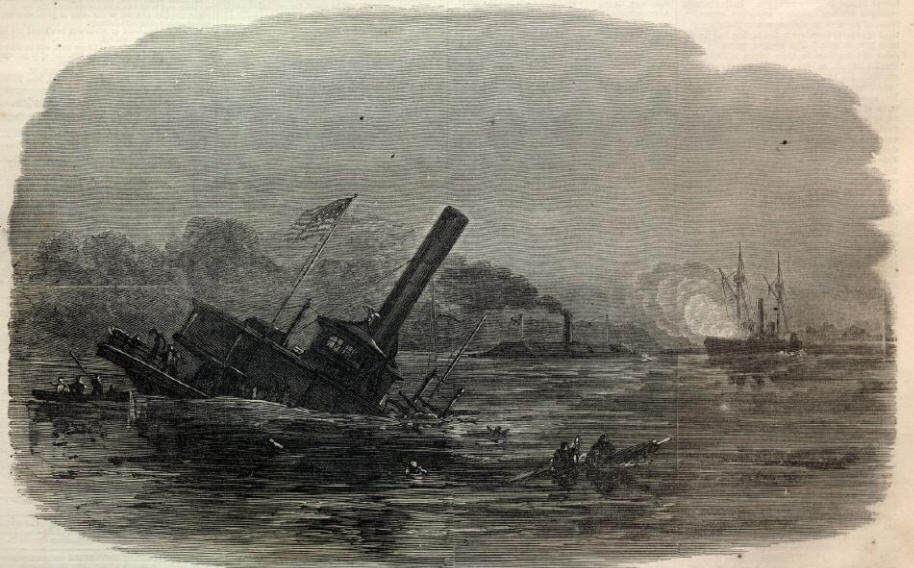
April 22, 1864 (Saturday): Grant Responds to Plymouth

Destruction of Federal Gunboats at Plymouth (Harper's Weekly)


CULPEPER, VA., April 22, 1864-11 a. m.
(Received 2.45 p. m.)
Major General H. W. HALLECK,
Chief of Staff:
    Admiral Lee's dispatch to the Secretary of the Navy has been sent to me for my information. I do not know the situation of affairs in North Carolina well enough to give positive instructions, but it appears to me there is no use of our holding Washington or Plymouth. It would be better to have the forces necessary to garrison those two places added to General Butler's column of attack, which, if successful, will give back to us not only the coast, but probably most of the State. It may be that to evacuate now would compromise Union men who have shown their Unionism in full faith that the country would never be given up to the enemy. I wish you would inquire of General Butler if the two points above mentioned can be abandoned as well as not, and, if so, give the order.


     U. S. GRANT,
     Lieutenant-General.

Official Records, Series I., Vol. 33, Part 1, Page 947.

Grant realized the setback in Plymouth would require the loss of part of North Carolina.  But he remained, as he would throughout the Overland Campaign, fixed on the real objective--Richmond.