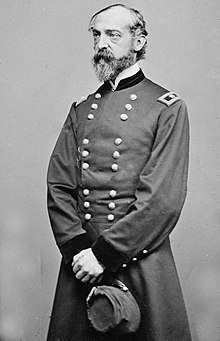
Tuesday, July 30, 2013

July 31, 1863 (Saturday): Lincoln Tries to Pull Back Arkansas

Senator William K. Sebastian

EXECUTIVE MANSION, Washington, July 31, 1863.
[Major-General HURLBUT:]
    MY DEAR GENERAL HURLBUT: Your letter by Mr. Dana was duly received. I now learn that your resignation has reached the War Department. I also learn that an active command has been assigned you by General Grant. The Secretary of War and General Halleck are very partial to you, as you know I also am. We all wish you to reconsider the question of resigning; not that we would wish to retain you greatly against your wish and interest, but that your decision may be at least a very well-considered one.
    I understand that Senator [William K.] Sebastian, of Arkansas, thinks of offering to resume his place in the Senate. Of course the Senate, and not I, would decide whether to admit or reject him. Still, I should feel great interest in the question. It may be so presented as to be one of the very greatest national importance; and it may be otherwise so presented as to be of no more than temporary personal consequence to him.

    The emancipation proclamation applies to Arkansas. I think it is valid in law, and will be so held by the courts. I think I shall not retract or repudiate it. Those who shall have tasted actual freedom I believe can never be slaves or quasi slaves again. For the rest, I believe some plan, substantially being gradual emancipation, would be better for both white and black. The Missouri plan, recently adopted, I do not object to on account of the time for ending the institution; but I am sorry the beginning should have been postponed for seven years, leaving all that time to agitate for the repeal of the whole thing. It should begin at once, giving at least the new-born a vested interest in freedom which could not be taken away. If Senator Sebastian could come with something of this sort from Arkansas, I, at least should take great interest in his case; and I believe a single individual will have scarcely done the world so great a service. See him, if you can, and read this to him; but charge him to not make it public for the present Write me again.
Yours, very truly,
A. LINCOLN.

Official Records, Series I., Vol. 24, Part 3, Pages 566-567.

Hurlbut was a close colleague of Lincoln's.  At the beginning of the war he was sent by Lincoln to Charleston to evaluate the situation at Fort Sumter.  The administration did, in fact, prevail upon him to remain in the Army.  But Sebastian did not rejoin the Senate, although that body did repeal his expulsion and compensate his family for the time he would have served after his death.  The noteworthy feature of the letter is Lincoln's flexibility on the subject of gradual emancipation.  Here he hopes Arkansas can be peeled away from the Confederacy through some middle ground proposal on the issue.

July 30, 1863 (Friday): An Epidemic of Desertion

North Carolina Soldiers (learnnc.org)


HEADQUARTERS ARMY OF NORTHERN VIRGINIA,
July 30, 1863.
Honorable JAMES A. SEDDON,
Secretary of War:
     SIR: I regret to send you the inclosed report of the adjutant [com-mander] of Scales' North Carolina brigade (Pender's old brigade), one which has done good service and reflected great credit upon that State. The officers attribute these desertions to the influence of the newspaper writers. I hope that something may be done to counteract these bad influences. From what I can learn, it would be well, if possible, to picket the ferries and bridges on James River and over the Staunton and Dan Rivers, near the foot of the mountains, in Halifax, Pittsylvania, Patrick, and Henry, at the most prominent points. Many of these deserters are said to pass that way, and it would be a great benefit to the army to catch them, in order to make some examples as speedily as possible.
     I am, very respectfully, your obedient servant,


     R. E. LEE,
     General.

     [Indorsement.]

AUGUST 7, 1863.
     I find it difficult to command the needed guards. Efforts will be made to do so.


     J. A. S. [SEDDON,]
     Secretary.

     [Inclosure.]

HEADQUARTERS SCALES' BRIGADE,
July 30, 1863.
Major [JOSEPH A.] ENGELHARD,
Assistant Adjutant-General:
      MAJOR: I am pained this morning to inform you that last night brought another slur on our old brigade, and consequently on our State. Out of our small number present, about 50 deserted-42 from the Twenty-second, and 5 from the Thirty-eighth [North Carolina Regiments]. If any more, they have not been reported. It is that disgraceful "pease" sentiment spoken of by the Standard. Some-thing should be done; every effort should be made to overhaul them, and every one should be shot. Let us hope to check it now, for if this should pass by unnoticed, many more will very soon follow. I ask what to do.
     Respectfully,


     WM. L. J. LOWRANCE,
     Colonel, &c.

Official Records, Series I., Vol. 27, Part 3, Page 1052.

It is clear soldiers on both sides had begun to lose the taste for war by 1863.   In the north newly arrived immigrants resisted the draft and in the south desertion was becoming more and more prevalent. 

Sunday, July 28, 2013

July 29, 1863 (Thursday): Lee Assesses Conditions


HEADQUARTERS ARMY OF NORTHERN VIRGINIA,
July 29, 1863.
His Excellency JEFFERSON DAVIS,
President of the Confederate States:
    Mr. PRESIDENT: Your letter of the 21st instant has been received and I am much obliged to you for the suggestions it contains. As soon as I receive an official account of the casualties in the army, it will be forwarded. The list of our wounded and missing I know will be large. Many of the first could not be moved, and had to be left behind. The latter will be swelled by the stragglers, who commenced, on crossing the Potomac, to stray from the line of march, and were intercepted by the enemy`s cavalry and armed citizens, notwithstanding every effort which was made to prevent it. Our people are so little liable to control that it is difficult to get them to follow any course not in accordance with their inclinations. The day after the last battle at Gettysburg, on sending back the train with the wounded, it was reported that about 5,000 well men started back at night to overtake it. I fear most of these were captured by the enemy`s cavalry and armed citizens, who beat their route. These, added to other stragglers, men captured in battle, and those of the wounded unfit to be transported, will swell our list of missing, and, as far as I can judge, the killed, wounded, and missing from the time we left the Rappahannock until our return will not fall short of 20,000. This comprises, however, the slightly wounded and those who straggled from the ranks, who are now rejoining us. After recrossing the Potomac, I commenced to consolidate the troops, considering the cases individually and united Archer`s and Heth`s (Field`s) former brigade under General H. H. Walker, and Pender`s and Heth`s divisions under General Heth. The accession of convalescents and stragglers is enlarging these divisions so much that I shall have to separate them again.
    As regards General Davis` Brigade, I think it will be better to attach the three Mississippi regiments to Posey`s brigade, in Andersons division, where I hope they will soon be increased in numbers. The North Carolina regiment of this brigade I suggest be attached to Pettigrew`s old brigade.
    The only objection to this plan is that it breaks up General Davis` command; but if his indisposition will detain him long from the field, it will be best to do it, for the present, at least. Although our loss has been so heavy, which is a source of constant grief to me, I believe the damage to the enemy has been as great in proportion. This is shown by the feeble operations since. Their army is now massed in the vicinity of Warrenton, along the Orange and Alexandria Railroad, collecting re-enforcemnts. Unfortunately, their means are greater than ours, and I fear when they move again they will much outnumber us. Their future plans I Cannot discover, and think it doubtful, with their experience of last year, whether they will assume the Fredericksburg line again or not, though it is very probable. Should they do so, I doubt the policy of our resuming our former position in rear of Fredericksburg, as any battle fought there, excepting to resist a front attack, would be on disadvantageous terms, and I therefore think it better to take a position farther back. I should like your views upon this point. The enemy now seems to be content to remain quiescent, prepared to oppose any offensive movement on our part. General Meade`s headquarters are at Warrenton. I learn by our scouts that the seven corps are between that point and the Orange and Alexandria Railroad. They are all much reduced in numbers. From the observation of some corps, the report of citizens and their prisoners, the reduction is general, and the corps do not exceed from 6,000 to 8,000 men. I have halted Ewell`s corps on Robertson River, About 3 miles in front of Madison Court-House, where grazing is represented to be very fine, and in the vicinity of which sufficient flour can be obtained. We have experienced no trouble from the enemy in crossing the Blue ridge. Excepting the attempt at Manassas Gap upon Ewell, and of a cavalry force on the Gourd Vine road on A. P. Hill, our march has been nearly unmolested. Our cavalry is in our front along the Rappahannock. I am endeavoring to collect all the provisions I can in this part of the country, which was also done in the Valley. While there, in order to obtain sufficient flour, we were obliged to send men and horses, thresh the wheat, carry it to the mills, and have it ground. There is little or no grain in that vicinity, and I cannot learn of more in Madison than sufficient for Ewell`s corps.
    Very respectfully, your obedient servant,


     R. E. LEE,
     General.


Official Records, Series I., Vol. 27, Part 3, Pages 1048-1049.

Did Lee delay as long as possible telling Davis the magnitude of his losses for fear word would spread to the press and embolden Meade to attack?  It is striking how long it took Lee to fully inform the government of his losses, although here he represents the toll on Meade's Army to be as great.  He believes Meade will not attack him, although it is possible in hindsight to believe Meade would have done so had he better information on Lee's location and intent.  The importance of the cavalry to these campaigns is evident in correspondence about this time.  Stuart's troopers remained active and the Union was not able to gather much information from behind the screen he established. 

July 28, 1863 (Wednesday): Meade Plans An Advance


General George Gordon Meade


HEADQUARTERS ARMY OF THE POTOMAC,
July 28, 1863-3 p. m. {Received 7. 35 p. m. }

Major General H. W. HALLECK,
General-in-Chief:
    I am making every effort to prepare this army for an advance. The principal difficulties encountered are the passage of the Rappahannock {at present unfordable, but which will probably be bridged to-night) also the want of animals for the batteries and cavalry, to supply which the quartermaster's department is doing everything possible. The recent marches in the mountain passes and the excessive heat of the weather caused a great loss of animals and the exhaustion of many others. A large proportion of the animals require shoeing. It is also necessary to accumulate subsistence stores to load the trains before starting. I am in hopes to commence the movement tomorrow, when I shall first throw over a cavalry force to feel for the enemy, and cross the infantry as fast as possible. My plan is to advance on the railroad to Culpeper and as far beyond as the enemy's positions will permit, to detach sufficient force to hold and guard the railroad from Manassas Junction, and thus test the question which has been raised of the capacity of the Orange and Alexandria Railroad to supply the army and the practicability of maintaining open such a long line of communication.
No reliable intelligence of the position of the enemy has been obtained. He pickets the Rappahannock from Fredericksburg to Rappahannock Station. These pickets, however, seem to be mere "lookouts, " to warn him of my approach. Some camps can be seen at Pony Mountain, near Culpeper, and in the vicinity of Cedar Mountain. Contradictory reports from citizens and scouts place the main body, some at Gordonsville, others say at Staunton and Charlottesville, and some assert the retreat has been extended to Richmond. My own expectation is that he will be found behind the line of defense, most of the fords being commanded by the southern bank, where his artillery can be used to advantage. If I can hold the railroad without too great a weakening of my force, and it proves to have the capacity to afford all the supplies needed, I shall advance until the enemy is encountered or definite information obtained of his movements. By holding the road, I do not refer to the force necessary to prevent the injuries caused by guerrillas, but against large bodies of cavalry or other forces placed on my flank and rear for the purpose of destroying my communications.


       GEO. G. MEADE,
       Major-General.

P. S.-4 p. m. -A scout just returned from across the river reports the enemy have repaired the railroad bridge across the Rapidan, and are using the road to Culpeper Court-House; that Lee has been intends to make a stand at Culpeper or in its vicinity.

Official Records, Series I., Vol. 27, Part 1, Page 105.

Meade believed himself under pressure from Lincoln to advance and attack Lee.  But the logistics of moving so many men over a considerable distance after a major battle worked against him, as did the current stage of the Rappahannock River.  It is interesting to note Lincoln's excitement by this time had cooled and he was not, in fact, urging Halleck to spur Meade to attack.  But there remained a lack of communication between Meade and Lincoln, perhaps because Meade was the least politically inclined of the generals who to this point had commanded the Army of the Potomac.
 

July 27, 1863 (Tuesday): The Wounded Still at Gettysburg

Adams Express Buckle (AdamsExpress.com)


WASHINGTON, D. C.,
July 27, 1863.
     SIR: I arrived at Gettysburg on the morning of the 10th of July, forty hours later than I had hoped to do, in consequence of the irregularities and interruptions on the railways leading to that place. Medical Inspector Volume reached Gettysburg some two or three days in advance of me, and immediately on his arrival made arrangements for sending away such of the wounded as were in a condition to be moved in ambulances or on the railroad. Lieutenant-Colonel Volume had the immediate charge of forwarding the wounded to the general hospitals designated by yourself. In this he was assisted by Dr. Osborne, of the Army of the Potomac, a very active and energetic officer. Both of these officers performed the duty assigned them with very great faithfulness and efficiency. I believe the wounded were received at the railroad depot and placed on the cars with as much care, attention, and comfort as was possible under the circumstances. Before the arrival of the fifty ambulances sent from Washington by yourself, our means of conveying the wounded from the field hospitals to the railroad depot were inadequate, although I am satisfied that as many ambulances were left by the Army of the Potomac as could possibly be spared. The number of medical officers detailed by Medical Director Letterman to remain with the wounded was thought to be sufficient, and probably might have been had not thousands of the enemy`s wounded been thrown unexpectedly on our hands. For some days after the battle, many of the rebel wounded were in a most deplorable condition, being without shelter of any sort, and with an insufficient number of medical officers and nurses of their own army. Every effort was made to alleviate the sufferings of these unfortunate men, and as soon as it could be done they were placed under cover or sent away to some general hospital. Our wounded with some few exceptions, were sheltered within a day or two after the battle, and made as comfortable as circumstances would permit. The scarcity of straw for bedding was seriously felt, and it was not until eight or ten days after the conflict that a sufficient quantity could be obtained. As far as my observation extends, the medical officers of the army, and the citizen surgeons who were employed during the emergency, discharged their arduous duties with fidelity and ability. I never saw men work harder and complain less of the difficulties that surrounded them. Through the efficiency of the medical purveyor, Assistant Surgeon [Jeremiah B.] Brinton, his storehouse was rapidly filled with supplies suitable for the occasion, and, by an arrangement of your own, liberal supply of ale and port is daily furnished to such of the wounded as need them. Up to the 25th instant (the day left Gettysburg), 15, 875 of the wounded had been sent away, and since that time 250 more have been forwarded, amounting in all to 16,125, leaving still at Gettysburg abut 3,500, 3,000 of whom, it is believed, are not in a condition to be moved at present. Those who are obliged to remain will be quartered in a large field hospital established at a suitable place near the town, where I hope they will have all the comfort and receive all the attention and kindness to which they are so justly entitled. I cannot close this brief report without acknowledging the immense aid afforded by the Sanitary and Christian Commissions. The promptness, energy, and great kindness uniformly exhibited by these benevolent associations doubtless helped to save the lives of many, and gladdened the hearts of thousands, who hold their good and noble deeds in grateful remembrance. To Adams Express we are also greatly indebted for much liberality and kindness extended to the wounded at a time when they were most in need.


     JOHN M. CUYLER,
     Medical Inspector, U. S. Army.

Official Records, Series I., Vol. 27, Part 1, Page 25.  Adams Express, a company still in business today, was a messenger service for companies which had no doubt extended its services to wounded soldiers.


July 26, 1863 (Monday): The Matter of Substitutes and Equality

Charles Sumner


 BOSTON, July 26, 1863.

Colonel FRY:
MY DEAR SIR: It is reported that (African-American) persons are not received as substitutes for white persons under the conscript act. If this be so I am at a loss to understand by what authority.
It was a part of the glory of this act that it made no distinction of color. If any such distinction be made under it, I cannot consider it otherwise than an interpretation utterly without sanction. It would follow therefore, first, that a (African-American) substitute can be taken as well as a white substitute. Indeed, a substitute is a substitute whether black or white.  Second, that all persons drafted must have the same pay. Here again there can no distinction of color.

On ground of policy, it seems to be obvious that (African-American) substitutes should be encouraged. Give me the slave as soldier rather than his master. If not too late, I hope this matter will be carefully examined; but it never can be too late to give a proper interpretation to a most important statute.
     Believe me, dear sir, faithfully yours,


     CHARLES SUMNER.

Official Records, Series III., Vol. 3, Part 1, Page 575.

Sumner was a radical republican senator, whose caning by South Carolina senator Preston Brooks in 1856 on the floor of the senate sparked even greater sectional animosity.  He supported Lincoln to an extent, but pursued his own agenda, notably that of a fierce prosecution of the war and strict support for equal rights.  Fry, to whom he writes, was in charge of the conscription program.  There was dispute as to whether white Americans could pay the $300 fee to exempt themselves from the draft by paying African-American substitutes.


July 25, 1863 (Sunday): Battle at Wapping Heights

Manassas Gap Battle-FaquierCivilWar.com

HEADQUARTERS ARMY OF THE POTOMAC,
July 24, 1863-8 p. m.
(Received, via Warrenton, July 25, 4. 10 p. m.)
Major-General HALLECK,
General-in Chief:
     I last night telegraphed you that, after driving the enemy through Manassas Gap, the head of the army, consisting of the Third Corps, had reached within a few miles of Front Royal at sunset, and was in the presence of a considerable force of the enemy, with batteries in position. Prisoners taken belonged to the several corps of the Confederate Army, and reliable intelligence was obtained of the arrival of Ewell's corps from Winchester at the close of the engagement. It was not until late in the evening that the army debouched from the pass sufficiently to deploy any larger force than the Third Corps, though this corps was followed immediately by the Fifth and Second. During the night, the Twelfth and two divisions of the Sixth were ordered up, and it was my intention, as reported to you, to attack with my whole force, in the hope of separating the force of the enemy and capturing such portions as had not reached the passes. I regret to inform you that, on advancing this morning at daylight, the enemy had again disappeared, declining battle, and though an immediate advance was made and Front Royal occupied, nothing was seen of him but a rear guard of cavalry with a battery of artillery. I then ascertained that for two days he had been retreating with great celerity principally through Strasburg and Luray, sending through Chester Gap sufficient force to cover his flank and hold me in check in my advance through Manassas Gap. As evidence of the hurried manner in which the enemy's retreat was conducted, is the fact of his abandoning some 80 wounded in Front Royal without any supplies. My cavalry have been employed in harassing the enemy, having captured numerous prisoners and several herds of cattle and sheep. Finding the enemy entirely beyond my reach, I have withdrawn the army from Front Royal, through Manassas Gap, and shall concentrate it in the vicinity of Warrenton and Warrenton Junction for supplies and to establish a base of communication. The losses in yesterday's engagement are reported to amount to some 200 killed and wounded, * among the latter General Spinola. The enemy is believe to have gone Culpeper, and probably beyond.


      GEO. G. MEADE,
      Major-General.


WASHINGTON, D. C., July 25, 1863-12. 30 p. m.
Major-General MEADE, Army of the Potomac:
    Your telegram of 10 p. m., 23d, is just received - the first communication from you for four or five days. The Quartermaster's and Commissary Departments have been prepared to send forward supplies, but were uncertain of the position of your army. Every possible effort has been made to send remounts to your cavalry, but the destruction of horses is enormous. Every serviceable horse in the country occupied should be impressed. They only serve for guerrillas.


    H. W. HALLECK,
    General-in-Chief.

Official Records, Series I., Vol. 27, Part 1, Pages 98-99.

On July 23, Meade ordered the III Corps, under Maj. Gen. William. H. French to cut off the retreating Confederate columns at Front Royal by forcing passage through Manassas Gap.  At first light, French began slowly pushing Walker’s Confederate brigade (Anderson’s division) back into the gap. About 4:30 pm, a strong Union attack drove Walker’s men until they were reinforced by Rodes’s division and artillery. By dusk, the poorly coordinated Union attacks were abandoned. During the night, Confederate forces withdrew into the Luray Valley. On July 24, the Union army occupied Front Royal, but Lee’s army was safely beyond pursuit (NPS).  This is also know as the Battle of Wapping Heights and the fighting occurred near Linden, east of Front Royal.