Sunday, January 6, 2019


Tuesday, June 3, 2014
May 3, 1864 (Thursday): On to Richmond
 |
| the Wilderness (vabattlefieldtours.com) |
ORDERS.] HEADQUARTERS FIRST DIVISION, SIXTH CORPS,
May 3, 1864.
This division will move to-morrow at 4 a. m. by way of Brandy Station and Stevensburg, following the Second Division. Order of march: First Brigade, Second Brigade, Third Brigade, ambulances. The First Brigade will follow close upon the Second Division. Fifty rounds upon the person, three days' full rations in the haversacks, three days' bread and small rations in the knapsacks, and three days' beef upon the hoof will be carried. The division will take half of its infantry ammunition, one hospital and one medicine wagon for each brigade, half of the ambulance train and the light spring wagons allowed at the various headquarters; the latter will precede the ambulances. No other train or means of transportation will accompany the division, except such wagons as will be necessary for forage for immediate use (five days). The subsistence and other trains loaded with forage, ammunition, & c., heretofore ordered, will be assembled under the direction of the acting quartermaster of the corps in the vicinity of Richardsville. The Fourth Brigade, Brigadier-General Shaler commanding, is detailed as guard for the trains of the corps, and will be so posted as to protect the train on the march and in park. No other guards will be allowed. Company commanders will be held strictly responsible that no straggling is allowed, and that the column is at all times well closed up. As it is very desirable to conceal this movement from the enemy, the strictest orders will be given and enforced in relation to bonfires; none must be allowed.
By command of Brigadier-General Wright:
HENRY R. DALTON,
Assistant Adjutant-General.
CULPEPER, May 3, 1864 - 3.30 p. m.
Major-General BURNSIDE, Warrenton Junction:
All of General Meade's troops will be away from Brandy Station to-morrow morning. You must have a force there to guard your stores. They should be started up at once.
U. S. GRANT,
Lieutenant-General.
Official Records, Series I., Vol. 36, Part 2, Page 362.
Grant was finally ready to move. Intense fighting lay ahead and so did Richmond.
May 2, 1864 (Wednesday): Mutiny?
 |
| General Samuel S. Carroll |
HDQRS. ARMY OF THE POTOMAC, Numbers 23. May 2, 1864.
The commanding general having learned that, notwithstanding the caution contained in General Orders, Numbers 22. of April 25, 1864, from these headquarters, * there are men in its army who refuse to do duty on the ground that their term of service has expired, it will be made known to such men that their conduct, being open mutiny, will be punished with death without trial unless they promptly return to duty; and, hereafter, any soldier who refuses to do duty on a similar plea will instantly be shot without any from of trial whatever. The honor of the service, and the necessities of the hour, admit of no other disposition of such cases. The commanding general again express the hope that the soldiers of this army will respectfully ask for and cheerfully abide by the decision of the War Department with respect to their term of service, but he has no further word of warning for those who, at at a time like the present, choose to defy lawful authority. Corps and other independent commanders are charged with the execution of this order.
By command of Major-General Meade:
S. WILLIAMS,
Assistant Adjutant-General.
HEADQUARTERS SECOND ARMY CORPS,
May 2, 1864.
Brigadier-General GIBBON,
Commanding Second Division:
GENERAL: The major-general commanding desires you to send to him at once a statement of the affair which occurred in the Eighth Ohio Volunteers yesterday, where certain men declined to do duty.
I am, general, very respectfully, your obedient servant,
C. H. MORGAN,
Lieutenant-Colonel and Chief of Staff.
[First indorsement.]
HEADQUARTERS SECOND DIVISION,
May 2, 1864.
A disturbance took place yesterday morning in the Eighth Ohio Volunteers. Measures were at once taken by Colonel Carroll to suppress it, and 12 of the ring-leaders were placed in irons. Every man has now returned to duty; a more healthy state of feeling exists, and no further trouble is anticipated. In case of such, however, I have directed that any man refusing to do duty will be shot on the spot.
Respectfully,
JOHN GIBBON,
Brigadier-General, Commanding Division
[Second indorsement.]
HEADQUARTERS SECOND ARMY CORPS,
May 2, 1864.
Respectfully forwarded for the information of the major-general commanding the Army of the Potomac.
W. S. HANCOCK,
Major-General, Commanding.
[Third indorsement.]
HEADQUARTERS ARMY OF THE POTOMAC,
May 2, 1864.
Respectfully returned to the commanding officer of the Second Corps.
Any refusing to do duty will be shot on the spot, being in open munity.
By command of Major-General Meade:
S. WILLIAMS,
Assistant Adjutant-General.
A general order will be issued on this subject to-day.*
S. WILLIAMS,
Assistant Adjutant-General.
* See Vol. XXXIII, p. 970.
* Transmitted to General Meade 1 p. m. May 2.
Official Records, Series I., Vol. 36, Part 2, Pages 331, 335, 336.
The 8th Ohio was a veteran regiment with a fine record, most recently at Gettysburg. Some troops in the regiment refused to continue service when their terms expired. With the Union and Confederate armies in close proximity and the possibility of combat Union commanders took extreme steps to keep soldiers from leaving the army.
Monday, June 2, 2014
May 1, 1864 (Tuesday): No Point Holding Back
 |
| Colonel Charles Scott Venable |
HEADQUARTERS,
May 1, 1864.
Lieutenant Colonel C. S. VENABLE,
Aide-de-Camp:
COLONEL: Your letter of yesterday is received. General Field will move to the vicinity of Gordonsville this afternoon or early to-morrow morning. As General Burnside's army is up in our front there can be but little use in holding any considerable force below Richmond, as there is no force of the enemy that can give us any trouble in that quarter. I hope, therefore, that at least Pickett's division may be sent up to us.
I remain, very respectfully, your obedient servant,
J. LONGSTREET,
Lieutenant-General, Commanding.
Official Records, Series I., Vol. 36, Part 2, Page 940.
The Union planned included a diversion from Fortress Monroe coming up the Peninsula. But the Confederate command quickly discounted this movement. Longstreet would need as much of his force as could be spared to join him.
April 30, 1864 (Monday): Anticipating Grant
 |
| General Henry W.Wessells |
FORT MONROE, VA., April 30, 1864.
Lieutenant- General GRANT:
The following, from a letter of General Wessells, at Plymouth, on the 16th, is forwarded for your information:
Longstreet's army is in motion for Richmond. Pemberton and many officers passed up to Richmond last week, and talked freely of the opening campaign. It is Lee's intention to anticipate General Grant's combinations; take initiative.
B. F. BUTLER,
Major- General.
Official Records, Series I., Vol. 33, Part 1, Page 1029.
The one part of this dispatch which was accurate was that it was Lee's intention to anticipate Grant's movements and take the initiative. Ironically, the more outnumbered Lee was by Grant the more important it was not to surrender the initiative. To fall back to Richmond was to either ultimately require the loss of the capital when, inevitably, the army withdrew or to become pinned down in or near the defenses of Richmond. The report was not entirely accurate, in that Longstreet was closing up to Lee's position near Culpeper.
April 29, 1864 (Sunday): Arm to Avoid Capture
 |
| Spencer Repeating Rifle |
HEADQUARTERS OF DIVISION,
Camp Hamilton, Va., April 29, 1864.
Major General B. F. BUTLER,
Commanding Department of Virginia and North Carolina:
GENERAL: In view of the approaching campaign, and more especially on account of the recent inhumanities of the enemy perpetrated upon troops of like character to those of my command, I deem it my duty to urge that these troops shall be more efficiently armed, to enable them to defend themselves and lessen their liability to capture.
There certainly ought to be no objection to arming these troops with as effective a weapon as any that are placed, in the hands of white soldiers, who are to go into battle with none of the peculiar disadvantages to which my men will be subject. The present arms of several regiments in the division are inferior in kind and manufacture. The Springfield rifled musket of the Bridesburg manufacture is an unreliable gun. The contract Enfield rifle is also unreliable, and one regiment is armed with the old Harper's Ferry smooth- bore. Now, these arms will suffice, perhaps, and were for troops who will be well cared for if they fall into his hands, but to troops who cannot afford to be beaten, and will not be taken, the best arm should be given that the country can afford.
The retaliation we should at present adopt is to arm our colored troops with Spencer repeating rifles, and I request that my division, or a part of them, may be armed with a repeating or breech- loading fir- arm.
I am, general, very respectfully, your obedient servant,
E. W. HINKS,
Brigadier- General, Commanding.
Official Records, Series I., Vol. 33, Part 1, Pages 1020-1021.
African-American troops had a legitimate concern of being shown no quarter after the recent events at Fort Pillow. But repeating rifles were in short supply and not likely to be provided to relatively inexperienced troops.
Thursday, May 29, 2014
April 28, 1864 (Saturday): Leaving Defenses Thin In Washington

 |
| Civil War Culpeper (O'Sullivan) |
WASHINGTON, April 28, 1864- 3.30 p. m.
Lieutenant- General GRANT,
Culpeper, Va.:
General Augur has been stripped of almost everything available to give to General Burnside. When the trains cease to run the guards under General Briggs can be placed in the block- houses, between Bull Run and the Rappahannock. I will also give him the Massachusetts detached artillery as soon as it arrives. No troops are yet available to replace Abbot's artillery in the fortifications. Perhaps some
militia or invalids from the West amy arrive in time. If not, we must weaken the other garrisons. There is very little left outside of Burnside's command to use against any movement of Longstreet. The Navy Department says that one iron- clad left New York and one left Philadelphia on the 26th, and should reach Fortress Monroe to- day. The one from Boston touched at New York, and will leave there to- morrow.
H. W. HALLECK,
Major- General, Chief of Staff.
Official Records, Series I., Vol. 33, Part 1, Pages 1002-1003.
Two years before the administration was at loggerheads with McClellan over whether he was leaving adequate troops to man the defenses of Washington. Now, under Grant, those same defenses were being stripped to allow Grant to maintain forces in front of Lee on the Rappahannock and in Eastern Virginia. At this point war planners were still uncertain exactly where Longstreet and his forces were located and what their intentions were.
April 27, 1864 (Thursday): Longstreet of the Valley?
 |
| "Shenandoah Valley" (William Lewis Sonntag) |
CULPEPER, VA., April 27, 1864-1.30 p.m.
(Received 3.20 p.m.)
Major General H. W. HALLECK,
Chief of Staff:
There are rumors brought in by deserters that Longstreet, re-enforced by Beauregard's troops, will move down the Shenandoah Valley. Should they do so, throw all the force as necessary. If such a movement is commenced by the enemy after we start from here I will follow him with force enough to prevent his return south.
U. S. GRANT,
Lieutenant-General.
Official Records, Series I., Vol. 33, Part 1, Page 992.
The Confederate high command had considered any number of options. But it was now a settled issue. Longstreet's troops, moving from Charlottesville, were now beginning to rejoin Lee's Army of Northern Virginia. Beauregard was giving up troops from the coast of South Carolina, given the weather made campaigning there difficult he was able to let some troops go.
Wednesday, May 28, 2014
April 26, 1864 (Wednesday): Again to Familiar Ground
 |
| Fredericksburg (npsfrsp.wordpress.com) |
HEADQUARTERS ARMY OF THE POTOMAC,
April 26, 1864-10.30 a.m.
Major General A. E. BURNSIDE:
I have now a pontoon bridge over the Rappahannock at the railroad crossing, in addition to the railroad bridge, which is planked over and can be passed by wagons. I shall take up the pontoon bridge when my troops are relieved. If you require another one, Brigadier-General Benham, at Washington, has been directed to furnish it, with the necessary working party, to lay and take care of it.
GEO. G. MEADE,
Major-General.
Official Records, Series I., Vol. 33, Part 1, Page 990.
Again to the bridges into Fredericksburg, again to Hamilton's Crossing, again to the plains of Fredericksburg. A familiar play, but with a new actor (Grant) in the lead role.
April 25, 1864 (Tuesday): The VMI Corp of Cadets Is Offered For Service
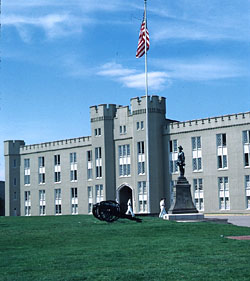 |
| VMI Lexington, VA |
HEADQUARTERS ARMY OF NORTHERN VIRGINIA,
April 25, 1864.
Major General WILLIAM H. RICHARDSON,
Adjutant-General of Virginia, Richmond:
GENERAL: Your letter of the 22nd instant, inclosing that of General Francis H. Smith, in which he proposes to tender the services of the Corps of Cadets at the Virginia Military Institute for the approaching campaign, is received. I desire to express my appreciation of the patriotic spirit that actuates General Smith in making this proposal, and my gratification at finding that it meets with your concurrence. I do not think, however, that it would be best at this time for the corps to be called to this army. It is now in a situation to render valuable aid in defending our western frontier, which may be menaced simultaneously with the general advance of the enemy in the east. It will thus prevent the necessity of detaching troops from this army. I think it would be advisable for General Smith to hold the command in readiness to co-operate with General Breckinridge and General Imboden in case of necessity, and to notify those officers of the fact. Should it at any time become necessary or expedient to have the services of the cadets with this army, it is very gratifying to me to know that they are so fully placed at my disposal.
Very respectfully, your obedient servant,
R. E. LEE,
General.
Official Records, Series I., Vol. 52, Part 1, Page 875.
VMI's cadets represented the future of the Confederate Army, but the future was in question. Smith's offer was not accepted by Lee at this time, but before the year was over the cadets would see action at New Market. For the time being, they provided a ready force in the Valley which meant Lee could avoid sending troops from his own command to the Valley.
April 24, 1864 (Monday): The Threat of A Single Gunboat
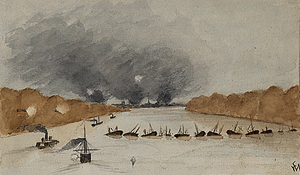 |
| Union Gunboats Advancing on New Berne |
HEADQUARTERS SUB-DISTRICT OF NEW BERNE,
New Berne, N. C., April 24, 1864.
Commander H. K. DAVENPORT,
Senior Naval Officer, Sounds of North Carolina:
SIR: I wish to call your attention to a few facts which, mentioned kindly, I hope you will take the same way, as I only say these things as a matter of duty, believing it for the best interests of both services.
You understand perfectly the situation of affairs here as far as the rebel ram on the Neuse is concerned, and you must be aware that if that ram is permitted to come into this harbor the shipping, gun-boats, &c., must be destroyed or driven away, and the town itself liable to destruction. I have done everything in my power to avoid such a disaster. The forces under my command have picketed
river on both sides, and the work on the blockade has been pushed as rapidly as possible. For months there has been no boat stationed anywhere near the blockade.
You will recollect that on the day before yesterday I earnestly urged you to send one of the small-boats, under your orders, to a point up the river where all parts of the blockade could be seen from her decks, and that small boats should at night row up nearer, in order to give us timely notice of any attempt to interfere with the work or to break through. There are points where such a gun-boat can lie perfectly well, and on the night before last I did find at mid-night when I made the rounds that the Lockwood or some other of the small gun-boats was lying in the channel between Fort Stevenson and Fort Anderson in a good position to see everything. Last night, however, there was no boat on the watch, and at 1.30 o'clock this morning, when Lieutenant Ward returned from his reconnaissance up to Swift Creek, there were no naval boats of any description seen higher up the river than where the Commodore Hull is lying.
Now, commander, do you not think that as these gun-boats lie quietly at their moorings for twenty-five days or more in every month that they ought to render some assistance at such a time as this? I have reluctantly come to the conclusion that they will not unless you give your personal attention to it and make your authority felt by your subordinates here.
I can say with pleasure that you have never refused to co-operate with me in any special undertaking, but you must recollect that I have frequently conversed with you concerning the precautions to be taken against surprise on the river and about keeping at least one of the small gun-boats busy in running into and examining the small rivers on the other side of the Neuse, where boat expeditions against us could be assembled. Have these things been done? I tell you, commander, that it is my firm belief that if that ram does get down the river it will be more on account of the utter indifference manifested by the naval forces here than anything else. You may be sure that I would not say this to you if I did not feel it my duty, and I repeat that I hope you will take it kindly, even if you are convinced that I am all wrong in the matter.
I am, commander, very respectfully, your obedient servant,
I. N. PALMER,
Brigadier-General.
Official Records, Series I., Vol. 33, Part 1, Page 969-970.
The threat posed by the ram Albemarle was very real to Union planners. An ironclad loose among wooden support ships could wreck the Union supply line by river. New Berne had defenses, but none strong enough to stop the ram from running the fortifications and shelling Union troops there.
Tuesday, May 27, 2014
April 23, 1864 (Sunday): A New Major General
 |
| USS Miami Damaged at Plymouth |
RICHMOND, VA., April 23, 1864.
Major General ROBERT F. HOKE:
(Via Rocky Mount, N. C.)
Accept my thanks and congratulations for the brilliant success which has attneded your attack and capture of Plymouth. Your are promoted to be a major-general from that date.
JEFFERSON DAVIS.
Official Records, Series I., Vol. 52, Part 1, Page 874.
olina
April 22, 1864 (Saturday): Grant Responds to Plymouth
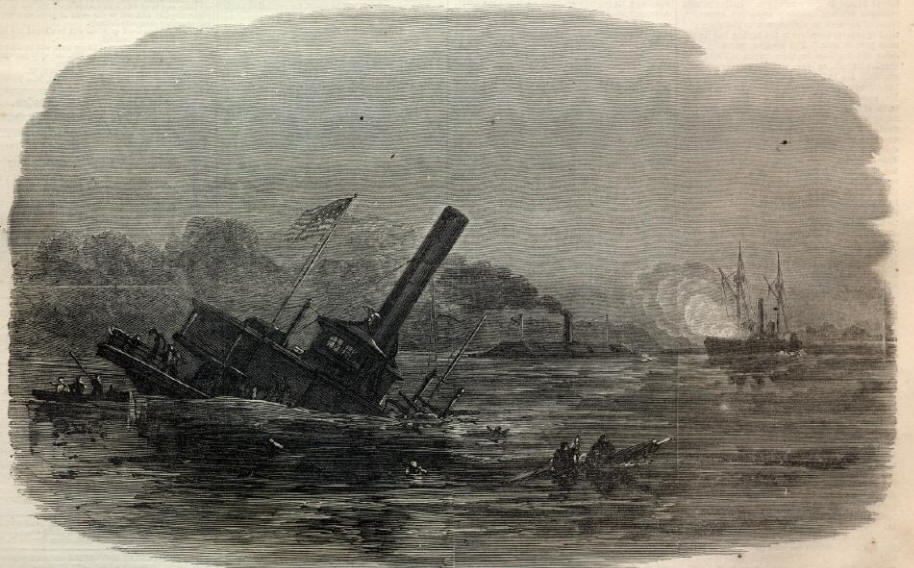 |
| Destruction of Federal Gunboats at Plymouth (Harper's Weekly) |
CULPEPER, VA., April 22, 1864-11 a. m.
(Received 2.45 p. m.)
Major General H. W. HALLECK,
Chief of Staff:
Admiral Lee's dispatch to the Secretary of the Navy has been sent to me for my information. I do not know the situation of affairs in North Carolina well enough to give positive instructions, but it appears to me there is no use of our holding Washington or Plymouth. It would be better to have the forces necessary to garrison those two places added to General Butler's column of attack, which, if successful, will give back to us not only the coast, but probably most of the State. It may be that to evacuate now would compromise Union men who have shown their Unionism in full faith that the country would never be given up to the enemy. I wish you would inquire of General Butler if the two points above mentioned can be abandoned as well as not, and, if so, give the order.
U. S. GRANT,
Lieutenant-General.
Official Records, Series I., Vol. 33, Part 1, Page 947.
Grant realized the setback in Plymouth would require the loss of part of North Carolina. But he remained, as he would throughout the Overland Campaign, fixed on the real objective--Richmond.
April 21, 1864 (Friday): Elation in Richmond
 |
| CSS Albemarle (navy.history.mil) |
PLYMOUTH, April 21, 1864.
General BRAGG,
Richmond, Va.:
I have stormed and carried this place, capturing 1 brigadier, 1,600 men, stroes, 25 pieces of artillery.
R. F. HOKE,
Brigadier-General.
PLYMOUTH, April 21, 1864.
His Excellency President DAVIS,
Richmond, Va.:
Heaven has crowned our efforts with success. General Hoke has captured this point with 1,600 prisoners, 25 pieces of artillery, and navy co-operation.
J. TAYLOR WOOD,
Colonel and Aide-de-Camp.
ROCKY MOUNT, April 21, 1864.
President DAVIS:
Will be in Richmond to-morrow. The prisoners will number about 2,500, 300 or 400 African-Americans, 30 pieces of ordnance, complete garrison outfit, 100,000 pounds of meat, 1,000 barrels of flour, and other provisions. All stores are being shipped up the river to Weldon. Two gun-boats were sunk, 1 crippled, and 1 small steamer captured. Where will thue prisoners go? Our loss about 300 in all. Colonel Mercer killed.
J. TAYLOR WOOD,
Colonel and Aide-de-Camp.
HEADQUARTERS ARMIES CONFEDERATE STATES,
Richmond, April 21, 1864.
His Excellency Z. B. VANCE,
Governor of North Carolina, Raleigh:
SIR: I have the pleasure to congratulate you upon the recent brilliant affair at Plymouth, under the leadership of the young North Carolianian, Brigadier-General Hoke. May we have many more such to refer to hereafter as part of the history of the campaign of 1864.*
I am, sir, with high regard, your obedient servant,
BRAXTON BRAGG.
General.
*Portion here omitted relates to prisoners of war.
Official Records, Series I., Vol. 52, Part 1, Page 870.
The Confederate victory at Plymouth prompted congratulations all around and praise for General Hoke. It was a rare victory at this stage of the war, rarer still in that it was a combined Army-Navy attack, and a relatively quickly organized and executed attack complete in execution and success. Although little noted by history, it was a clear setup to Union hopes of tying down Confederate forces with an expanded front south of Richmond.
Monday, May 26, 2014
April 20, 1864 (Thursday): Longsstreet to Petersburg
 |
| General James Longstreet |
HEADQUARTERS,
Orange County, April 20, 1864.
General J. LONGSTREET:
GENERAL: I received last night your letter of the 18th, by your courier.* I regret that your troops are coming in so slowly. Can you not expedite them? As far as I can judge by the reports of our scouts, the enemy are all prepared to advance, packed, provisioned, and equipped, and waiting only for the ground to dry. Around us it is dry now, save in spots, and we may expect them any day. Their artillery, ambulances, and pontoons are brought south of the Rappahannock, but I cannot ascertain what route they will take. Sutlers, sick, women, &c., sent to Washington. I have not heard of Burnside's expedition leaving Annapolis, and have no way of learning, save through their papers. Reports from Richmond received from deserters state that he is assembling his troops at Williamsburg. A dispatch from Elzey, received last night, reports upon information of a citizen from Williamsburg that he was landing troops at Yorktown and Gloucester Point. I think it doubtful. It certainly lacks confirmation. As to your going to Petersburg, you can best judge whether you can be spared from your command and what arrangements you can make for it. Your visit there, if not inconvenient and disadvantageous to your troops, may have the effect you anticipate, and if you think best you can go. Let me know what troops have arrived and who will command in your absence, &c. I send the authority in case you should want to use it. I have endeavored to push forward the intrenchments around Richmond as fast as possible for years. They are in pretty good condition now, except the injury sustained through the winter, and they are connected with Chaffin's Bluff. If you go to P. you must return quickly.
Very truly,
R. E. LEE,
General.
Official Records, Series I., Vol. 52, Part 1, Page 869.
It is not clear by Longstreet wanted to go to Petersburg. However, he had temporary command there during the Suffolk campaign and had expressed concern about the defense of the area. In one sense, Longstreet may have been testing Lee as to what his relationship would be on returning to the Army. Lee wasted no time in making it clear Longstreet was required to return to the Army of NorthernVirignia.
Sunday, May 25, 2014
April 19, 1864 (Wednesday): Plymouth Attacked
 |
| Ausbon House, Plymouth (Duckworth, civilwaralbum.com) |
APRIL 19, 1864.
Colonel RIPLEY:
Plymouth has been attacked. Keep your scouts out well on the roads to watch the enemy. Have a strong picket along the bank, so as to prevent any attempt on Macon. Hold the 400 colored men subject to your orders for defense temporarily. So distribute your men as to have all your can available for any service. Ask the naval commander to aid you in the protection of Morehead and other places.
JOHN J. PECK,
Major-General.
APRIL 19, 1864-9.50 a. m.
Colonel CLAASSEN,
Commanding Outposts, &c.:
The news is that Plymouth has now been attacked. General Wessels writes that he has had some fighting and lost some men. New Berne may yet be the point to look out for.
PALMER,
General.
Official Records, Series I., Vol. 33, Part 1, Page 917.
Hoke's force had moved rapidly on Plymouth, supported by the ram Albemarle. The ram's appearance on the 19th coincided with the four regiments of infantry surrounding the Union defenses. Twenty-eight hundred men under Wessel were effectively trapped and would surrender the next day.
April 18, 1864 (Tuesday): Longstreet Rebuked
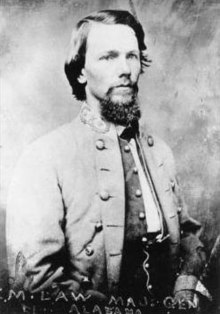 |
| General Evander Law |
HDQRS. ARMIES OF THE CONFEDERATE STATES,
Richmond, April 18, 1864.
General S. COOPER:
GENERAL: I learn by a note from General Lee that Longstreet has transferred Law's brigade to Buckner, and left it at Bristol. This should be corrected by telegraph. As the charges against General Law are not sustained by the Department he should be restored to his command. Allow me to suggest early action on McLaw's case. He should be with his division. Allow me to suggest General Holmes for the duty of organizing and commanding the reserves in North Carolina. General Lee suggests the movement of Beauregard's surplus forces this way, to be ready to relieve Pickett, who should go to him. As the re-enforcements to the enemy in Florida seem really to have been the removal of the enemy from there, ought not our troops to come on to North Carolina, instead of again being buried in the district system in Georgia and South Carolina?
BRAXTON BRAGG.
RICHMOND, VA.,
April 18, 1864.
Major General S. B. BUCKNER,
Bristol, Tenn.:
Send Law's brigade to Charlottesville to report to General Field. General Law will be relieved from arrest and put in command of it. The charges against him will not be further entertained.
S. COOPER,
Adjutant and Inspector General.
Official Records, series I., Vol. 32, Part 3, Page 793.
McLaws had been court martialed, on his charges preferred by Longstreet, for his actions in the Fort Sanders debacle. He had been convicted on only one of the three charges (for failing to organize his forces for the attack) but Richmond recognized the charges were an attempt by Longstreet to assign blame for his mistakes elsewhere. Cooper ordered the charges removed. Longstreet had also preferred charges against Law (for insubordination) and left his troops behind when he returned with the remainder of the First Corp to the Army of Northern Virginia. In this he was overruled by Cooper and the authorities in Richmond. McLaws would be transferred out of Lee's Army and Laws was held under arrest for a large portion of the Overland Campaign.
Saturday, May 24, 2014
April 17, 1864 (Monday): Conclusion of the Dahlgren Affair
 |
| Ruins of Dover Steam Mill |
HDQRS. ARMY OF THE POTOMAC, April 17, 1864.
General ROBERT E. LEE,
Commanding Army of Northern Virginia:
GENERAL; I received on the 15th on the 15th instant, per flag of truce, your communication of the 1st instant, transmitting photographic copies of two documents alleged to have been found upon the body of Colonel U. Dahlgren, and inquiring "whether the signs and instructions of Colonel Dahlgren, as set forth in these papers, particularly those contained in the above extracts, were authorized by the United States Government or by his superior officers, and also whether they have the sanction and approval of these authorities. " In reply I have to state the neither the United States Government, myself, nor General Kilpatrick authorized, sanctioned, or approved the burning of the city of Richmond and the killing of Mr. Davis and cabinet, nor any other act not required by military necessity and in accordance with the usages of war.
In confirmation of this statement I inclose a letter from General Kilpatrick, and have the honor to be, very respectfully, your obedient servant,
GEO. G. MEADE,
Major-General.
[Sub-inclosure.]
HEADQUARTERS THIRD DIVISION, CAVALRY CORPS, April 16, 1864.
Brigadier General S. WILLIAMS, A. A. G.,
Army of the Potomac:
GENERAL: In accordance with instructions from headquarters Army of the Potomac, I have carefully examined officers and men who accompanied Colonel Dahlgren on his late expedition.
All testify that he published no address whatever to his command, nor did he give any instructions, much less of character as set forth in the photographic copies of two papers alleged to have been found upon the person of Colonel Dahlgren and forwarded by General Robert E. Lee, commanding Army of Northern Virginia. Colonel Dahlgren, one hour before we separated at my headquarters, handed me an address that he intended to read to his command. That paper was indorsed in red ink, "Approved," over my official signature. The photographic papers referred to are true copies of the papers approved by me, save so far as they speak of "exhorting the prisoners to destroy and burn the hateful city and kill the traitor Davis and his cabinet," and in this, that they do not contain the indorsement referred to as having been placed by me on Colonel Dahlgren's papers. Colonel Dahlgren received no orders from me to pillage, burn, or kill, nor were any such instructions given me by my superiors.
Very respectfully, your obedient servant,
J. KILPATRICK,
Brigadier-General Volunteers.
Official Records, Series I., Vol.33, Part 1, Page 180.
This would close the Dahlgren affair. The Confederate government chose to accept the Union explanation. Perhaps this was, in part, because the Rebel government was itself engaged in a variety of activities outside the "normal usages of war." Historians still debate whether Dahlgren had orders which extended beyond the original warrant of the raid. It is curious Kilpatrick accepted that the papers accurately reflected what he endorsed with the exception of the exhortation to destroy the city and kill Davis. Assuming the Confederate authorities had not altered the papers, there is still the possibility Dahlgren intended to exceed the authority given him by Kilpatrick.
April 16, 1864 (Sunday): March for Washington City
_FSTV_CWDW-0064.jpg/800px-Civil_War_Defenses_of_Washington_(Fort_Stevens)_FSTV_CWDW-0064.jpg) |
| Fort Stevens Washington DC |
HEADQUARTERS.
Charlottesville, Va., April [16?], 1864.
General R. E. LEE,
Commanding, &c,. Orange Court-House:
GENERAL: The troops are coming in very slowly, owing to our very imperfect railroad arrangements. We cannot hope to have the command up before the middle of next week.
It may have a good effect during this delay for me to go to Petersburg and remain. By leaving my horses, &c., with the command I could get back by express train in full time for any emergency. If the enemy learns that I am at Petersburg he will in all probabilty assume that my troops are with me and that is the point at which my corps will rendezvous instead of this.
If such should be the effect he will move with more caution in that direction and more boldness in this, and we may, by this means, here until we learn that the army at Annapolis has set out on its intended expedition; then, having all things well prepared, I think that we should take up the shortest line of march for Washington City. We will be able to get between the enemy and his capital, and, by pushing on toward it, we will force him to give battle hurriedly in order to save his capital. If he does that we ought to have great reason to hope that we may destroy him and get this capital.
It seems to me that this will be our safest and best move, whatever may be the service intended for General Burnside's army. If he goes up York River or to Urbanna we would force Meade to fight before Burnside could join him. If he goes to the south side of the James we ought to be able to get Washington before he could get back there.
I suggested last fall the idea of fortifying Richmond below, so as to hold the river at Drewry's and Chaffin's Bluffs with our vessels and about 10,000 men. In the course of the summer's campaign it may become necessary to use all of the rest of your troops in such a manner as to leave Richmond exposed. If it should so turn out, and the enemy should get there and get possession of the river, he will hold it for the balance of the war; but if we can even hold the position on the river we will be able to recover Richmond very readily, even if we should have the bad fortune to lose it temporarily.
I remain, general, very respectfully, your most obedient servant,
J. LONGSTREET
Lieutenant-General.
Official Records, Series I., Vol. 33, Part 1, Pages 1286-1287.
Longstreet here joins the number of high ranking Confederates who have begun thinking about the possibility of Richmond being lost for some period of time. His proposal to take Washington may seem fanciful in light of what was to come, but it was based on the Union having moved many of the defenders in the Washington defenses to the front. Richmond was vulnerable but so was Washington.
April 15, 1864 (Saturday): A Crowning Victory
 |
| General Robert E. Lee |
HEADQUARTERS, April 15, 1864.
MR. PRESIDENT: The reports of the scouts are still conflicting as to the character of the re-enforcements to the Army of the Potomac and the composition of that at Annapolis under General Burnside. I think it probable that the Eighth Corps, which embraces the troops who have heretofore guarded the line of the Baltimore and Ohio Railroad, the intrenchments around Washington, Alexandria, &c., have been moved up to the Rappahannock and that an equivalent has been sent to Annapolis from General Meade.
Lieutenant-Colonel Mosby states that the Eleventh and Twelfth Corps, consolidated, have also been sent to General Burnside. But whatever doubt there may be on these points, I think it certain that the enemy is organizing a large army on the Rappahannock, and another at Annapolis, and that the former is intended to move directly on Richmond, while the latter is intended to take it in flank or rear. I think we may also reasonably suppose that the Federal troops that have so long besieged Charleston will, with a portion of their iron-clad steamers be transferred to the James River. I consider that the suspension of the attack on that city was virtually declared when General Gillmore transferred his operations to the Saint John's River. It can only be continued during the summer months by the fleet. The expedition of the enemy up Red River has so diminished his forces about New Orleans and Mobile that I think no attack upon the latter city need be apprehended soon, especially as we have reason to hope that he will return from his expedition in a shattered condition. I have thought, therefore, that General Johnston might draw something from Mobile during the summer to strengthen his hands, and that General Beauregard with a portion of his troops might move into North Carolina to oppose General Burnside should he resume his old position in that State, or be ready to advance to the James River should that route be taken. I do not know what benefit General Buckner can accomplished; but if he can only hold Bristol, I think he had better be called for a season to Richmond. We shall have to glean troops from every quarter to oppose the apparent combination of the enemy. If Richmond could be held secure against the attack from the east, I would propose that I draw Longstreet to me and move right against the enemy on the Rappahannock. Should God give us a crowning victory there, all their plans would be dissipated and their troops now collecting on the waters of the Chesapeake would be recalled to the defense of Washington. But to make this move I must have provisions and forage. I am not yet able to call to me the cavalry or artillery. If I am obliged to retire from this line, either by a flank movement of the enemy or the want of supplies, great injury will befall us. I have ventured to throw out these suggestions to Your Excellency in order that in surveying the whole field of operations you may consider all the circumstances bearing on the question. Should you determine it is better to divide this army and fall back toward Richmond I am ready to do so. I, however, see no better plan for the defense of Richmond than that I have proposed.
I am, with great respect, your obedient servant,
R. E. LEE.
General.
Official Records, Series I., Vol. 33, Part 1, Pages 1282-1283.
The most telling line of Lee's letter to Davis was "If I am to retire from this line...great injury would befall us." Grant's objective was to push Lee back toward's Richmond, Lee's to consolidate his forces and maintain his line as far north as possible. Lee considered the entirity of Confederate forces in making his plans. He assumed the Red River campaign would fail and Mobile would be, for a time, safe from attack. And he now began to give more focus to the problem of North Carolina. As always, Lee's thoughts turned toward the offensive, and striking a blow against Grant.
Subscribe to:
Comments (Atom)