Monday, September 2, 2013

September 3, 1863 (Saturday): Hill Counsels Bragg

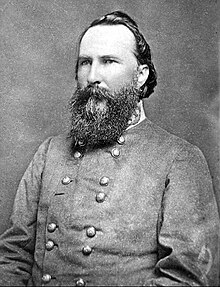
General D. H. Hill


CAMP NEAR BRIDGE, September 3, 1863.
General BRAGG, Commanding Army:
     GENERAL: If the Yankees have really crossed in force at Caperton's, it seems to me plain that the movement is for Chattanooga, in order to secure the railroad as an entirety. They will work their way up Will's Valley until they get in position to drive us from Chattanooga. The road will then be put in operation from Bridgeport. They have evidently spared Chattanooga with the view of using it hereafter; otherwise they would destroy the depot and town.
     I cannot but think that Burnside will be left in some secure place above with his infantry, while his cavalry hold the railroad until Rosecrans secures this end of it. They will then be in condition to hold the country, bring in their supplies, operate among the disloyal portions of East Tennessee and Western North Carolina. This is, I think, the programme. The great object is East Tennessee. I have no idea that a movement of infantry will be made against Atlanta. The mounted men will be put upon that work. Rosecrans will avoid battle till Grant is ready to move. The whole Yankee policy for some time past has been that of combined movement. They have had one controlling mind, while we have had no combinations whatever. If we cannot get a fight from Rosecrans before Grant shall move, Johnston will want help and another retreat becomes inevitable.
     I know the country too imperfectly and have too little confidence in my own judgment to counsel any particular course of action, but I have felt so uneasy about the delay that I cannot refrain from expressing my anxiety. If we wait until the meshes be thrown around, we may find it hard to break through. If it ever becomes practicable for us to take the initiative at any time, we would thereby as effectually frustrate Rosecrans as you did at Murfreesborough by the same course.
     With great respect,


     D. H. HILL,
     Lieutenant-General.

Official Records, Series I., Vol. 30, Part 4, Page 588.

Bragg could not afford to become yet another Confederate general to be captured defending a critical point with inferior numbers and lines of supply.  He would be forced to abandon Chattanooga and seek an opportunity to strike Rosecrans before he could, as Hill surmised, move to control eastern Tennessee and Western North Carolina.  Hill had been sent west, unable to work for Lee.  He was of some ability, but much disposed to offer opinions and cantankerous in the extreme.

September 2, 1863 (Friday): Longstreet Has Other Ideas

Longstreet Statue at Gettysburg

HEADQUARTERS,
September 2, 1863.
General R. E. LEE,
Commanding, &c.:
    GENERAL: Your letter of the 31st is received. I have exprssed to Generals Ewell and Hill your wishes, and am doing all that can be done to be well prepared with my own command. Our greatest difficulty will be in preparing our animals. I do not know that we can reasonably hope to accomplish much here by offensive operations, unless you are strong enough to cross the Potomac. If we advance to meet the enemy on this side, he will, in all probability, go into one of his many fortified positions; these we cannot afford to attack.
   I know but little of the condition of our affairs in the west, but am inclined to the opinion that our best opportunity for great results is in Tennessee. If we could hold the defensive here with two corps, and send the other to operate in Tennessee with that army, I think that we could accomplish more than by an advance from here.
    The enemy seems to have settled down upon the plan of holding certain points by fortifying and defending, while he concentrates upon others. It seems to me that this must succeed, unless we can concentrate ourselves, and, at the same time make occasional show of active operations at all points. I know of no other means of acting upon that principle at present, excepting to depend upon our fortifications in Virginia, and concentrate with one corps of this army, and such as may be drawn from others, in Tennessee, and destroy Rosecrans' army. I feel assured that this is practicable, and that greater advantage will be gained that by any operations from here. I remain, general, very respectfully, your most obedient servant,


    JAMES LONGSTREET,
    Lieutenant- General.

Official Records, Series I., Vol. 29, Part 2, Pages 693-694.

 Longstreet had long wished to be detached for Western service and would soon get his wish in the Chickamauga Campaign.  It would seem a reasonable guess to believe Longstreet knew more about the effort in Richmond to secure his and his corps' services than he would admit directly to.  But Lee must have read this with some sense of Longstreet's involvement in the matters he had just been summoned to Richmond to discuss.  It should be remembered during the Chancellorsville campaign Longstreet wrote an almost identical letter to Lee regarding why Lee should be able to hold Northern Virginia with Longstreet's corp remaining in the Suffolk region.  Lee treated both Jackson and Longstreet with perhaps more defference than he should, failing to show the aggressive nature he brought to his campaigns to his dealings with his subordinates.

September 1, 1863 (Thursday): Colonel George S. Patton

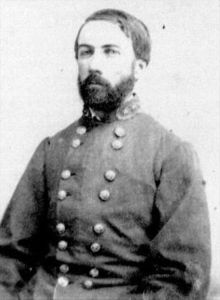
Colonel George S. Patton

September 1, 1863.
Colonel GEORGE S. PATTON,
Commanding, &c.:
    COLONEL: The major- general desireds that you communicate with him at Dublin by way of Union until further instructions. He wishes you to scout to Gauley, and send some reliable men to the Kanawha Valley, as he is anxious to learn, as soon as possible, any information of the forces, &c., in that locality.
    Will you please send a courier up the Antony's Creek road to a Mr. Hall's, 5 miles above Dolan's, and direct him to bring a wagon left there by our temaster on the march. The horse had best be turned over to the quartermaster at Lewisburg.
     Respectfully,


     WM. B. MYERS,
     Assistant Adjutant- General.

Official Records, Series I., Vol. 29, Part 2, Page 693.

This would be the grandfather of the World War Two general of the same name.  Patton was an able officer, active in the Valley, who would be killed at Third Winchester and posthumously promoted to general.


August 31, 1863 (Wednesday): Confidential to General Longstreet


General James Longstreet


RICHMOND, VA., August 31, 1863.
CONFIDENTAL.]
Lieutenant General J. LONGSTREET,
Headquarters Army of Northern Virginia:
     GENERAL: I have wished for several days past to return to the army, but have been detained by the President. He will not listen to my proposition to leave to-morrow. I hope you will use every exertion to prepare the army for offensive operations and improve the condition of men and animals. I can see nothing better to be done than to endeavor to bring General Meade out and use our efforts to crush his army while in its present condition. The Quartermaster's Department promises to send up 3,000 bushels of corn per day, provided the cars can be unloaded and returned without delay. I hope you will be able to arrange so that the cars will not be detained. With this supply of corn, if it can be maintained, the condition of our animals should improve.
      Very respectfully and truly, yours,


     R. E. LEE,
     General.

Official Records, Series I., Vol. 52, Part 1, Page 761.

Lee knew Davis desired to detach Longstreet's Corp to send to Bragg's aid but a final decision had not been reached.  Lee wanted to mount one last offensive in the fall to crush Meade's Army of the Potomac.  A careful reading of this message reveals Gettysburg had far less of an impact on Lee's Army than might be imagined, since Lee still believed the Army of Northern Virginia capable of crushing Meade.

August 30, 1863 (Tuesday): A Boat Raid in the Rappahannock


WASHINGTON, D. C., August 30, 1863-12 noon.
Major-General MEADE,
Army of the Potomac:
    An iron-clad and several gunboats will leave the mouth of the Rappahannock to-morrow morning, and will probably reach Port Royal about night. The object is to recapture the two gunboats taken by the enemy and now in that river. It is very possible that these vessels, being small, may run up toward Fredericksburg, into shallow water, where our vessels cannot pursue. It is, therefore, desirable that you send a force of cavalry and artillery down this side of the river, to assist in destroying them. This force will run the risk of being cut off, by the enemy's throwing troops across the river in their rear. Hence the greatest caution must be taken to watch the river and the enemy's movements. The whole operation will be a delicate one, and the most careful officers should be placed in charge.


     H. W. HALLECK,
     General-in-Chief.

Official Records, Series I., Vol. 29, Part 2, Page 111.

The Satellite was a converted tugboat, which was captured along with the tug Reliance on the Rappahanock River by Confederate forces under Captain John Taylor Wood.  Wood was the grandson of President Zachary Taylor and nephew of Confederate President Jefferson Davis.  Wood seized additional small vessels before eventually destroying the Satellite to prevent its recapture.


August 29, 1863 (Monday): Battles Continue Around Charleston


Fort Gregg (dickenson.edu)

Captain W. F. NANCE,
Assistant Adjutant-General.
[MORRIS ISLAND, August 29, 1863.]
     CAPTAIN: I have the honor to submit the following report of operations during last night and to-day:
     The enemy remained very quiet during the night, there being little or no firing from their sharpshooters or batteries. They commenced no new work, but were engaged in strengthening their lines already begun. The fire from our batteries on James Island was irregular, sometimes very effective. The guns at Fort Wagner did good service, greatly disturbing the enemy at their work. During the day, an irregular fire has been kept up on both sides. The 9-inch Dahlgren at Fort Gregg was dismounted this morning by a shot from the enemy's land battery.
     No serious damage has been done at Fort Wagner.
     The disposition of troops is the same as last reported, except that the Twenty-third Georgia is in position at the works in the place of the Fifty-fourth Georgia, which has been sent to Fort Gregg to be in readiness to take the boat for Fort Johnson to-night.
     Inclosed you will find a report of the casualties since last report.*
     Lieutenant Randle, my aide-de-camp, received this evening a dangerous and, I fear, fatal wound. He has been distinguished for his coolness and gallantry upon many bloody battle-fields. I shall greatly lament his loss.
     Respectfully submitted.


     A. H. COLQUITT,
     Brigadier-General,

    Captain W. F. NANCE
    Assistant Adjutant-General.

 *None.

Official Records, Series I., Vol. 28, Part 1, Page 447.

Operations around Charleston Harbor continued with Union forces attempting to gain a foot hold on Fort Wagner. 

August 28, 1863 (Sunday): The Old Familar Places


Hamilton's Crossing (CivilWarAlbum.com, Richard Ederling)

HDQRS. CAVALRY CORPS, ARMY OF THE POTOMAC,
August 28, 1863-8 a. m. (Received 8. 20 a. m.)
Major-General HUMPHREYS,
Chief of Staff:
    GENERAL: General Kilpatrick reports 3 deserters from McLaws' division. They crossed last evening, and state their division left Raccoon Ford four days ago, and marched to Wall's Tavern, where it is receiving supplies from Frederick's Hall, on the Virginia Central Railroad. Pickett's division is on the telegraph road near Fredericksburg. Hood's is between Hamilton's Crossing and Port Royal.
    A brigade of infantry under General Cooke is at Fredericksburg, not assigned. Wall's Tavern is about 10 miles northeast from Frederick's Hall.

   The force on the peninsula between the Potomac and Rappahannock consists of three regiments of infantry and one of cavalry, with four guns, near King George Court-House. They have a picket line from Lamb's Creek Church to the Potomac, and are taking large quantities of forage to the opposite side of the river from Port Conway.
    Colonel Gregg reports all quiet and no change in his front. Jenkins' and Jones' brigades of cavalry are near Sperryville. General Buford reports no changes in his front.
    Very respectfully,


    A. PLEASONTON,
    Major-General, Commanding.

Official Records, Series I., Vol. 29, Part 2, Pages 105-106.

The battlegrounds, campgrounds, and byways of the war had become familiar names.  Racoon Ford would be familiar with students of Jackson at Cedar Mountain.  Frederick's Hall was a major way station for supply.  And well did Hood's troops know the area of Hamilton's Crossing on the old Fredericksburg battleground.