Wednesday, August 7, 2013

August 7, 1863 (Saturday): Moving an Army

Union Wagons at Petersburg

HEADQUARTERS OF THE ARMY,
Washington, D. C., August 7, 1863
Major-General MEADE,
Commanding Army of the Potomac:
    GENERAL: I inclose herewith a copy of General Orders, Numbers 274, in advance of printed copies. This order is based on that of General Taylor in moving from the Rio Grande on Monterey, but the allowance is more liberal, and yet, I have no doubt, many will consider it niggardly, being so much below that formerly permitted to the Army of the Potomac. I am satisfied, however, from the experience of General Grant in Mississippi, and of General West in his march from California to New Mexico, that there is no necessity for the large trains heretofore allowed, and for which there is no parallel in European warfare. I am satisfied, moreover, that when our armies become accustomed to this allowance, it may be still further reduced without any serious inconvenience.
    One thing is certain, we must reduce our transportation or give up all idea of competing with the enemy in the field. Napoleon very correctly estimated the effective strength of an army by its numbers multiplied by its mobility; that is, 10,000 men who could march 20 miles per day as equal to 20,000 men who could march only 10 miles per day. Unless we an reduce our impedimenta very considerably, we can equal the enemy only by a vast superiority in numbers.
    While your army is inactive this matter should be thoroughly studied, and the land transportation reduced to a much lower standard. By comparison with other armies now in the field, and our armies in the Mexican war, as well as with European armies in campaign. I am satisfied a very great reduction can be made in the transportation of the Army of the Potomac, and moreover, until this reduction is actually made, we can expect no decided successes in the field by that army, no matter how much heroic bravery it may exhibit on the battle-field. I understand from General Ingalls that a very great reduction of transportation has been made within the last month.
     During this extreme heat, troops and animals should be moved as little as possible.
      Very respectfully, your obedient servant,


      H. W. HALLECK,
      General-in-Chief.

Official Records, Series I., Vol. 29, Part 2, Page 13.

Logistical insufficiency is a problem, but so is excess.  The Army of the Potomac was so well supplied with wagons and supplies it was not able to move as rapidly as the Army of Northern Virginia.  Halleck applies one of Napoleon's maxims to the situation and comes to a conclusion which the remainder of the war would bear out.  Mobility was more to be desired than comfort. 

Monday, August 5, 2013

August 6, 1863 (Friday): "The rascals ate some of our bread."

Colonel Wirt Adams


Vicksburg, MISS., August 6, 1863.
General WILLIAM T. SHERMAN:
     I have directed General Hurlbut to send a force from Memphis to meet one from here, to collect rolling-stock on the Central and Memphis roads, and repair roads, and take it to Memphis, if possible. * Start your cavalry on Monday next. Let them collect the stock on the Central road and get it on to the Memphis road; then push north until they meet the party from Memphis. If the whole force is necessary for security, the cavalry from here can remain with that from Memphis until they get through, then return by the river. Impress upon the men the importance of going through the State in an orderly manner, abstaining from taking anything not absolutely necessary for their subsistence whilst traveling. They should try to create as favorable an impression as possible upon the people, and advise them, if it will do any good, to make efforts to have law and order established within the Union. It should be our policy now to make as favorable an impression upon the people of the State as possible.


     U. S. GRANT.

HEADQUARTERS Fifteenth ARMY CORPS,
August 6, 1863.
General GRANT:
     Your instructions about the cavalry expedition are received. It will give me excessive pleasure to instruct the cavalry as you direct, for the policy you point our meets every wish of my heart. I have seen gentlemen from Clinton.
    Some of Wirt Adams' cavalry are about Jackson, and the rascals ate some of our bread, under protest of the people. It is said Johnston is at Morton, at a station east of Brandon, his cavalry near Brandon. Why he stays there, I can't imagine. His advance had got out to Chunkey's 68 [miles] from Jackson, but, it seems, have moved back this way. My informant says he thinks Johnston hates to give up Mississippi, and remains as near Jackson as he has railroad, but his men are dispirited, and are deserting.


      W. T. SHERMAN.

Official Records, Series I., Vol. 24, Part 3, Page 578.

Grant had Vicksburg and now he wanted to secure supply lines to move out into Mississippi.  After the fall of Vicksburg Adams troops combine with remnants of another regiment to form a semi-autonomous command which frequently skirmished with Union forces.  

Sunday, August 4, 2013

August 5, 1863 (Thursday): Western Combinations

General Samuel Cooper


CHATTANOOGA, TENN., August 5, 1863.
General J. E. JOHNSTON,
Morton, Miss.:
    DEAR GENERAL: On the 2nd instant I received this dispatch from General Cooper: "If we can spare most of Johnston's army temporarily to re-enforce you, can you fight the enemy?" Hardee had previously dispatched that he was ordered to be ready to re-enforce me. Knowing nothing definite of your means, I was utterly unable to answer, and therefore asked the conference to benefit by your advice, and requiest you to take the command in case we determined on the move. Before receiving your reply I learned from Gneeral Hardee, through General Polk, what your efective force was, and promptly informed the Department that the means would be entirely inadequate to enable me to seek the enemy beyond the mountains. I inclose a copy of my letter to General Cooper.  To "fight the enemy" is a very simple operation when you have the means and can get at him. But with less than half his strength, and a large river and 50 to 100 miles of rugged, sterile mountain, destitute even of vegetation, between you and him, with our limited commissariat, the simple fighting would be a refreshing recreation. This being the only conclusion at which I can arrive, the defensive seems to be our only alternative, and that is a sad one.
     Very truly and faithfully, yours,


     BRAXTON BRAGG.

Official Records, Series I., Vol. 52, Part 2, Page 514.

The Confederacy's problem in the west was the vastness of the area.  It necessitated dividing forces among various armies and departments and then seeking to make combinations so as to attack the Union forces at advantage.  Far too often, the result was the loss of small divisions of the total at some indefensible outpost or other (Forts Henry and Donaldson, Vicksburg).  Logistically, there was also a lack of adequate rail resources to shift men quickly or to maintain supplies.  Beyond this, the nature of the generals sent west was not conducive to offensive operations.  Johnston and Bragg were professionals who had a professional soldiers eye for every deficiency in their forces, but lacked the offensive minded nature of Lee or Jackson.  Cooper was inspector general of the Army, answering only to Davis, and was one of five full generals in the Confederate army.

August 4, 1863 (Wednesday): Pickett's Report Rebuked


Field of Pickett's Charge (GettysburgDaily.com)


[No date.]
General GEORGE E. PICKETT,
Commanding, &c.:
      GENERAL: You and your men have crowned yourselves with glory' but we have the enemy to fight, and must carefully, at this critical moment, guard against dissensions which the reflections in your report would create. I will, therefore, suggest that you destroy both copy and original, substituting one confined to casualties merely. I hope all will yet be well.
    I am, with respect, your obedient servant,


     R. E. LEE,
     General.

Official Records, Series I., Vol. 27, Part 3, Page 1075.

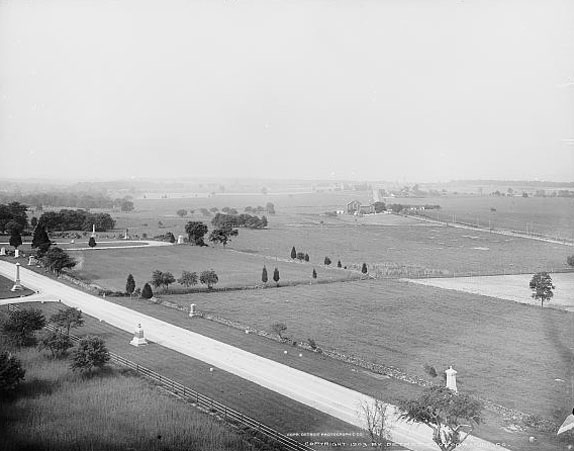
There is no Pickett report on Gettysburg in the Official Records, leading one to believe Pickett never rewrote his report or at the least one was never accepted from him.  It is likely the report would have cast aspersions on the support Pickett's Virginia Division received from North Carolina troops on his left during the advance.  At a time when desertions among North Carolina troops were at epidemic levels and support in the state for the war was waning, this would not do.

Saturday, August 3, 2013

August 3, 1863 (Tuesday): Stuart Reports In

General J. E. B. Stuart


HDQRS. CAVALRY DIV., ARMY OF NORTHERN VIRGINIA,
August 3, 1863-9 a. m.
[General R. E. LEE:]
     GENERAL: No change since yesterday perceptible. Scouts were near the bridge last night and report incessant work as if on bridge. The same heavy dust prevails this side of the bridge as yesterday. I am disposed to believe enemy will entertain us with a threat of advance and wait for re-enforcements. The very improbable part of the report of prisoners to General Fitz. Lee is that the Twelfth Corps was moving so secretly. Now, if the Twelfth Corps crosses over here it is very importable that that corps would be taken back for the flank movement. I sent some scouts across below here and some above in addition to those already over. Just heard from Amissville. At least a brigade of cavalry still there. Last night a rumbling of wagons was heard at Beverly all night moving from the direction of Warrenton to Rappahannock bridge. It was not heard to proceed beyond that point. There are no facts on which we can predicate a conclusion yet, but we will watch the enemy. Two notes received this morning. Fitz. Lee will not come while there is any prospect of an advance.
      Most respectfully,


      J. E. B. STUART,
      Major-General.

Official Records, Series I., Vol. 52, Part 1, Page 750.

This letter is included not so much for great historical import as for an example of Stuart's role in the Army.  Scouting was a primary role, but he also served an intelligence function, taking in the information and evaluating the likely course of the enemy.  In today's world of satellite technology it is difficult to imagine armies separating after a battle and becoming, to a great extent, lost to each other.  But such often was the case and the danger of a portion of the army being fallen upon by its opponent was very real.  This was the enormous valley of a highly competent cavalry officer like Stuart. 

Thursday, August 1, 2013

August 2, 1863 (Monday): Defending Charleston Harbor


CSS Palmetto State (http://cottageindustrymodels.com)


HDQRS. DEPT. SOUTH CAROLINA, GEORGIA, AND FLORIDA,
Charleston, S. C., August 2, 1863.
Captain J. R. TUCKER,
Commanding C. S. Naval Forces Afloat, Charleston Harbor, S. C.:
    CAPTAIN: In reply to your request for my opinion whether the private steam vessels which have been seized by you "can render more important service by going abroad than by being retained for the defense of the harbor," I have to say, that I am convinced the time for their effective employment for the defense of this harbor is now, in some effort to destroy at night the Ironsides and other iron-clad vessels of the enemy, which are being formidably used for the reduction of our works on Morris Island. If they are not speedily applied to that end, or cannot be with sufficient hope of success to warrant or induce the attempt, but are to be held in the inner harbor, only to be resorted to in the last extremity against iron-clads that shall have overpowered our out-works and reduced or passed Forts Sumter an Moultrie, then I am clearly satisfied their further retention as a means of defense is useless, and that it will be far better to release them at once, as requested by the Quartermaster's Department, to be sent abroad for military supplies.
      Respectfully, your obedient servant,


      G. T. BEAUREGARD,
      General, Commanding.

Official Records, Series I., Vol. 24, Part 3, Page 1070.

At various times the Confederates had a makeshift fleet of as many as 20 vessels in Charleston Harbor.  The vessels alluded to here were medium sized steamers which would not have been very effective in combat against the more powerful Union fleet blockading the harbor.  But they were, unlike the improvised ironclads of the Confederacy, capable of putting to sea and escaping to Europe.  Beauregard wanted them to hazard an attempt on the Union ships, but only if it were done before additional northern ships could be added to the blockade.


August 1, 1863 (Sunday): A Leak Investigation

General Joseph E. Johnston

RICHMOND, VA., August 1, 1863.
General JOSEPH E. Johnston,
Commanding, &c.,:
     SIR: I inclose to you a communication published, as you will observe, in the newspapers.
There is interval evidence that it was written by some one having access to your correspondence, and a copy of a letter written by one of your staff has been exhibited in this city which contains passages so identical with the published communication as to leave little room for doubt as to its origin.
It is needless to say that you are not considered capable of giving countenance to such efforts at laudation of yourself and detraction of others, and the paper is sent to you with the confidence that you will take the proper action in the premises.
     Very respectfully, your most obedient servant.


     JEFFERSON DAVIS.

MORTON, August 11, 1863.
His Excellency the PRESIDENT, Richmond:
    Your letter of the 1st instant and the newspaper article inclosed with it just received. I have neither seen nor heard of it before. My staff officers present know nothing of it. It is clearly based upon information only to be had in my office. It shall be investigated.


     J. E. Johnston.
  
Official Records, Series I., Vol. 24, Part 3, Page 1070.

Davis and Johnston were never on the best of terms, so it must have been difficult for Johnston to be shown evidence of indiscretion in his professional family.  Beyond that, it represented a breach of security.