Tuesday, February 25, 2014

January 30, 1864 (Thursday): The Thanks of Congress

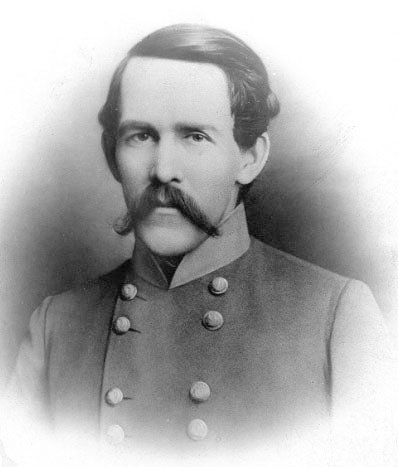
Major Heros von Borcke


[No. 44.] - JOINT RESOLUTION of thanks to Major General J. E. B. Stuart, and the officers and men under his command.
   
     Resolution of thanks by the Confederate Congress to Major Heros von Borcke. Whereas Major Heros von Borcke, of Prussia, assistant adjutant and inspector general of the cavalry corps of the Army of Northern Virginia, having left his own country to assist in securing the independence of ours, and by his personal gallantry in the field having won the admiration of his comrades as well as that of his commanding general, all of whom deeply sympathize with him in his present sufferings from wounds received in battle: Therefore, Resolved by the Congress of the Confederate States of America, That the thanks of Congress are due, and the same are hereby tendered, to Major von Borcke, for his self-sacrificing devotion to our Confederacy, and for his distinguished services in support of its cause. Resolved. That a copy of the foregoing resolution be transmitted to Major von Borcke by the President of the Confederate States. Approved January 30, 1864.

Official Records, Series I., Vol. 27, Part 2, Page 712.

Von Borcke sought adventure and on hearing of the advent of war in America made his way to the Confederate states through Bermuda.  A cavalry officer in Prussia he attached himself to Stuart's command and the two become good friends.  He participated in all of Stuart's campaigns until severely wounded at Middleburg.  He later resumed active service with Stuart as a staff officer and finished the war on a diplomatic mission to England.

January 29, 1864 (Wednesday): Aroused From My Nocturnal Repose

Colonel Alfred Gibbs


UNOFFICIAL.] HDQRS. CAVALRY RESERVE BRIGADE,
January 29, 1864.
Brigadier General W. MERRITT,
Commanding First Division Cavalry, Culpeper:
    DEAR GENERAL: Since we have been deprived of the pleasure of judicially assassinating that deserter to-day, I shall endeavor to elevate my depressed spirits by literary composition. Now, general, when we were ruthlessly thrust out to the front, where we have since been kept at the point of the bayonet, we were promised a division of infantry to protect us. Well, they have never done it. These regiments of General Robinson's have been in Culpeper all the time, and last night about 1 o'clock I was aroused from my nocturnal repose by General Robinson's dispatch informing me that the Cedar Run brigade was to be withdrawn to-day, and that he wanted his pickets relieved by cavalry.
    I understand that another division was ordered to relieve General Robinson's, but mean time that division had erected a theater in town, and of course it could not be thought of that they should go to the front and leave the theater behind. Now, we don't want their infernal old sharp-sticks at all, and I think we will be safer if they will withdraw the other brigade, so that if we are run back we won't have to wait until they pack up their duds and skedaddle back to their present position.
    They have left 100 men as a guard to the four blind signal officers on Cedar Mountain. It is reported that some camp-fires were seen yesterday in the woods north and west of Thoroughfare Mountain; perhaps that will account for the brigade changing front to rear so suddenly. The patent-sight man yesterday took four shots while the enemy were firing at Somerville Ford, and says he hit two certain. Mr. Emmons, assistant adjutant-general, will communicate to you some views of mine with regard to the picket-line on our left, which I desire to have changed. Lieutenant Walker is still basking in the sunshine of beauty.
   We still live, move, and have our being; somewhat muddy.
    Very respectfully, yours,


    ALFRED GIBBS,
    Colonel, &c.

Official Records, Series I., Vol. 33, Part 1, Pages 440-441.

Gibbs, as evidenced by his word smithing here, was well educated.  He attended Dartmouth prior to graduating from West Point.  A career soldier, he fought in the Mexican War and on the plains prior to the Civil War.  He remained in the army after the war, but died in 1868 of what was then called "congestion of the brain."


January 28, 1864 (Tuesday):Preserving Farms


GENERAL ORDERS,
HDQRS. ARMY OF NORTHERN VIRGINIA, Numbers 10.
January 28, 1864.
     In order to afford every facility and encouragement to the farmers to prepare for planting the coming season, the general commanding directs that particular attention be given to the preservation of the fencing and the closing of roads through fields which the owners may desire to cultivate. The gaps in the inclosures of such fields which have been made by the army will be closed by the nearest command, and passage across them by persons mounted or on foot and by vehicles will be strictly prohibited. Travel will be confined to the regular roads of the country as far as practicable.
Corps and division commanders will see to the strict enforcement of this order, and give to farmers in their vicinity all the assistance in their power.
     The general commanding is confident that it is only necessary to remind the army of the importance of a supply of provisions for its use, and that of the people, to insure a cheerful compliance by all.


     R. E. LEE,
     General.

Official Records, Series I., Vol. 33, Part 1, Page 1126.

Armies occupied vast amounts of rich farm land.  In the case of the Army of Northern Virginia, that farm land had been occupied and reoccupied for the duration of what was now a long, hard war.  Lee was here making sure that the farmers who provided the crops which fed his army had the best chance of being productive, even if that meant his soldiers had to take the long way around to get from point to point. 


Monday, February 24, 2014

January 27, 1864 (Monday): Lee Evaluates His Officers

General Robert E. Rodes


HEADQUARTERS, Orange Court-House, January 27, 1864.
Mr. PRESIDENT:
   I have not been unmindful of your request, expressed in your letter of the 16th instant,* desiring my opinion in reference to the reorganization of the troops in West Virginia. It is the difficulty of this subject and the importance of selecting a proper commander that has caused my silence. There are many able officers in this army, and many, I have no doubt, capable of administering that department, could I designate them. All have done well in their present positions, but to send them to a new and difficult field would be an experiment. But so important do I consider the maintenance of Western Virginia to the successful conduct of the war that I will relinquish any of them you may select for its command, though I do not know where to replace them. A change, I think, is necessary, both for the country. The duties might be more unsuitable to the health of General Ewell than his present position. I have also great confidence in the ability of Generals Early, Rodes, Edward Johnson, and Wilcox. Of the brigadiers, I think General Gordon, of Alabama, one of the best. I do not know to what duty General Buckner is assigned, but of the officers that have seen serving in that department I think General Ransom is the most prominent. If any of these officers be selected, and they should not answer, they should be removed and another tried.
    If a proper man can be found I think it would be better to include the Shenandoah Valley in his command, in order that he might concentrate the troops where most necessary. A better discipline should be instituted among the troops themselves. Their local character should be abolished by law, all deserters from other armies be returned to their proper commands, and all authority to organize companies, either within or without the enemy's lines, be revoked. This authority causes desertion from the general service. Men go within the enemy's lines, either really or nominally, with the connivance or invitation of the officers, to enter these organizations. In a word, the system should be such as to organize the men of the country for its defense, and not for their convenience or the benefit of certain individuals. Unless this is done the resources of that country will be lost to us, both its mineral wealth and provisions. The first step to improvement is an energetic, active commander, and no time should be lost in his selection.
     I have the honor to be, your obedient servant,


     R. E. LEE,
     General.
---------------
*See G. W. C. Lee to R. E. Lee, p. 1091.

Official Records, Series I., Vol. 33, Part 1, Page 1124.

Left off the list were Anderson and Heth.  Lee was personally fond of Heth, but he had not distinguished himself at Gettysburg, nor had Anderson.  Hays had served during the Mine Run campaign in charge of Early's division, but was not equal to the others in rank, being only a brigadier general.  No 1st Corp officers were mentioned, as all were with Longstreet in Tennessee.  Early would ultimately take this command, with mixed results.

January 26, 1864 (Sunday): Forrest Afloat

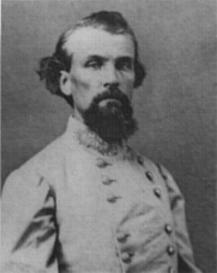
General Nathan B. Forrest


HEADQUARTERS DISTRICT OF EASTERN ARKANSAS, Helena, Ark., January 26, 1864.
Captain HENRY N. PAYNE,
Commanding Liberia Guards, 4th Ark. Vols., African Descent:
    SIR: It is reported that the rebel Colonel Forrest constructed a raft and made a raid on Island Numbers 63, last night.
    You will embark your company on the S. B. Bertha at 11 a. m. and proceed to the island, where on arrival you will ascertain all the facts and co-operate with Captain Holibaugh. You will take such steps as the contingency demands, using a sound discretion, and return and report as soon as practicable.
     Your obedient servant,


     N. B. BUFORD,
     Brigadier-General, Commanding.

Official Records, Series I., Vol. 32, Part 2, Page 228.

Forrest remained active during this period, launching numerous raids.  He had the advantage of the vastness of the territory in which he operated and the speed of cavalry often moving against infantry.  But his forces were generally not large enough to inflict substantial damage.

January 25, 1864 (Saturday): The North Carolina Question

North Carolina Capital (NC Division of Archives and History)


HOUSE OF REPRESENTATIVES, January 25, 1864.
[Governor VANCE:]
    SIR: In consultation of our delegation this morning with the President in regard to public affairs in North Carolina, the President read to us a communication made by himself to you in reply to a letter of yours upon the subject of negotiating with the United States Government for the termination of the war. He did not read your letter to him, to which his was a response, and we do not know what were the views expressed by you to him in your letter. The letter of the President to you contains information which would be interesting to our people, and we are of the opinion that its publication would have a happy effect not only in our State, but upon public opinion throughout the Confederacy. There may be something in your letter to the President which you do to care to make public, and if so, the letter of the President alone would effect our object in getting his views before the public. The President informed us that the letter was a public paper in the hands of yourself, and that its publication was a matter for your consideration; that he certainly had no objection to its being made public. In that state of facts, we have thought proper to suggest the publication of this correspondence, or at least the letter of the President, thinking that it will remove much prejudince against the President now existing in our State upon the subject of peace and peace propositions.
     We have the honor to be, your obedient servants,


A. H. ARRINGTON.
E. G. READE.
J. R. McLEAN.
W. N. H. SMITH.
THOS. D. McDOWELL.
B. S. BAITHER.
THOS. S. ASHE.
A. T. DAVIDSON.
R. R. BRIDGERS.
O. R. KENAN.
WILLIAM LANDER.

Official Records, Series I., Vol. 52, Part 1, Page 813.

Vance had written Davis to state there was pressure on him from within the state to press the Confederate government to open negotiations with the Lincoln administration.  Davis' response was carefully crafted and set forth the case there could be no negotiations given the administration's stance on the war. 

January 24, 1864 (Friday): Supplying the Cavalry

General Fitzhugh Lee


HEADQUARTERS ARMY FO NORTHERN VIRGINIA, January 24, 1864.
Major General J. E. B. STUART,
Commanding Cavalry, Army of Northern Virginia:
    GENERAL: In connection with the disposition of the two brigades of Fitz. Lee's division now near Charlottesville, as proposed by Major-General Lee and indorsed by you, I am directed by the general commanding to say that he desires that the transportation of this command be kept together and well cared for. Perhaps a portion of it can be judiciously employed by Major-General Hampton in foraging and supplying the brigades of Young, and Gordon, as General Hampton has expressed a desire for additional wagons for this purpose. Such as is not turned over to him for temporary service must be placed together under the proper officer of the quartermaster's department, who shall see that the animals are properly foraged and protected and the wagons placed in the best possible condition. If the transportation cannot be properly attended to in this way, it must be turned over to Major Harman, the acting chief quartermaster of the army, until required by the troops.
    General Lee directs me to add that Major-General Early reports that Major-General Lee carried off with him some fifteen or sixteen of the captured wagons and most of the captured mules. Every one of them must be turned in to the chief quartermaster of the army and a report of the number of wagons and mules promptly made to these headquarters.
     The general commanding wishes the headquarters of Lee's cavalry division, after the contemplated disposition shall have been effected, established at some point nearer the troops of the division now in front, say west of Orange Court-House, and somewhere between Lomax's brigade and the camps in rear.
     I am, most respectfully, your obedient servant,


     W. H. TAYLOR,
     Assistant Adjutant-General.

Official Records, Series I., Vol. 33, Part 1, Page 1119.

We think of generals in grand terms moving large portions of their armies across large expanses of campaign territory.  But this memo shows that generals also had to concern themselves with many smaller details, such as the placement of Fitz Lee's division and provision for it's wagons.